- Whatsapp: 8618958900507
- Email: [email protected]


ASME B16.9 (B16.9 for short) is the ASME standard for Factory-Made Wrought Butt-Welding Fittings, developed by the American Society of Mechanical Engineers. It specifies the dimensions, tolerances, materials and inspection of butt-welding fittings such as elbows, tees and reducers, and it covers pipe sizes from NPS 1/2 to NPS 48 (DN15–DN1200).* In short, B16.9 governs how a fitting is made and measured — not how much pressure it can carry.
*per ASME B16.9
B16.9 specifies four things: dimensions and tolerances, end bevels (which point to ASME B16.25), marking, and hydrostatic testing. On hydrostatic testing, note the wording: the standard requires the fitting to be capable of passing a hydrostatic test — it does not mean every fitting is individually pressure-tested. What your order states is what decides what the supplier delivers.
What B16.9 leaves out matters just as much. It does not assign a pressure-temperature rating (Section 4). It does not name material grades — those are referenced to ASTM: A234 and A420 for carbon and low-alloy steel, A403 and A815 for austenitic and duplex stainless steel, B366 for nickel, B361 for aluminium, and B363 for titanium. It does not cover corrosion allowance or the welding procedure.
B16.9 also draws a boundary around size, joint and manufacture. Its dimensional range runs NPS 1/2 to NPS 48 (DN15–DN1200); larger fittings usually fall to MSS SP-75, and sizes below NPS 1/2 are covered by ASME B16.11. It covers one joint only — butt welding, a full-penetration joint that can be checked by ultrasonic or radiographic testing. Socket welds, which form fillet welds and cannot be volumetrically tested, fall under B16.11 with a different quality-control logic. Thin-wall stainless fittings in low-pressure corrosive service are covered by a dedicated standard, MSS SP-43 (see Section 6), and non-ferrous and cast-iron parts are outside the scope.
In one line: B16.9 ensures the fitting matches the pipe and welds on cleanly — it does not say how much pressure the line can carry.

B16.9 covers eight types of industrial pipe fittings (see the table below).
| Type | Function | Note |
| Elbow 90° / 45° | Change of direction | Radius selection is covered in the elbow guide |
| Return 180° | Reverses flow | More wall thinning on the outer curve |
| Tee, straight / reducing | Branch connection | Reducing outlet must be stated, not assumed |
| Cross | Four-way branch | Higher stress concentration; rarely specified |
| Reducer, concentric | Size change on centreline | Not for horizontal pump suction |
| Reducer, eccentric | Size change, one side flat | Flat side up on pump suction, or gas collects and the pump cavitates |
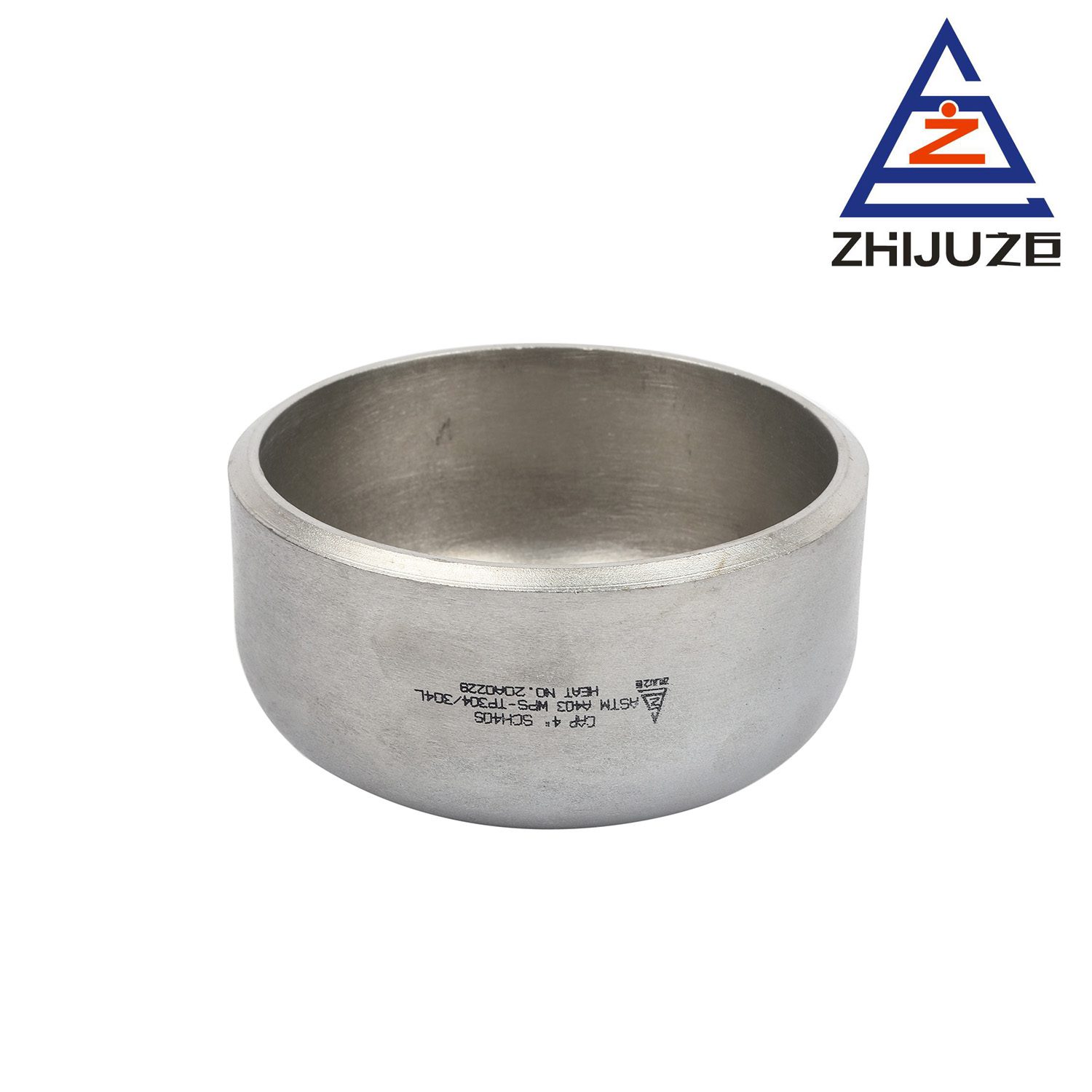
| Cap | Closes a line end | Permanent, unlike a blind flange |
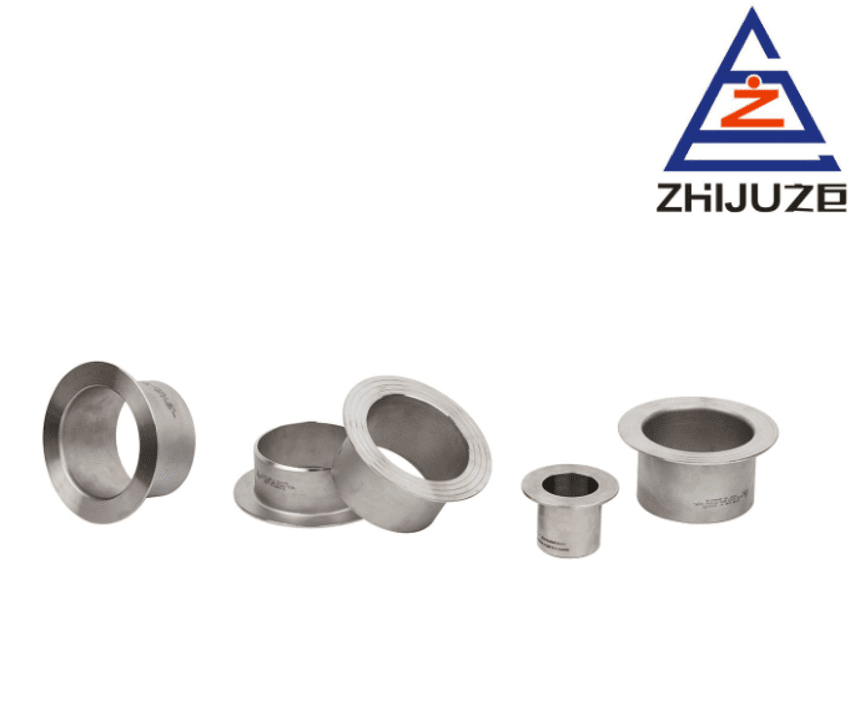
| Lap joint stub end | Pairs with a loose flange | Lets the flange rotate for bolt alignment |
ZHIJU data: our butt weld fittings are manufactured to ASME B16.9, with GB / JIS / DIN / GOST also available, in sizes DN15–DN2000 and grades TP304L / 316L / 310 / duplex 2205 / 2507 — confirm the current range at the time of enquiry.
No. B16.9 sets dimensions, tolerances, end preparation, testing and marking — it does not assign a pressure class. There is no such thing as a “B16.9 Class 3000” fitting. Pressure classes belong to other standards: B16.5 for flanges (Class 150–2500) and B16.11 for forged socket-weld and threaded fittings (Class 2000–9000).
Once a fitting is welded into the line, what carries the pressure is the weld and the pipe wall — not the fitting body on its own. So a butt-weld fitting’s pressure-temperature rating follows the pipe it matches: same material, same wall thickness, calculated under the governing piping code — ASME B31.3 for process piping, B31.1 for power piping.
For buying, that means one thing: the fitting takes the material and wall thickness of the pipe. Two signals worth noticing. A supplier who asks “what class do you need” is probably confusing B16.9 with B16.11. And a quotation that reads “B16.9 Class 3000” was written by someone who is not clear which family they are selling.
These two get mixed up more than any other pair. B16.9 is wrought butt-weld fittings in large bore, NPS 1/2 to 48, joined by full-penetration groove welds, with no pressure class. B16.11 is forged socket-weld and threaded fittings in small sizes, NPS 1/8 to 4, and those do carry classes: 2000, 3000, 6000 and 9000. You can see the table below for your comparison.
| ASME B16.9 | ASME B16.11 | |
| Fitting type | Wrought butt-weld | Forged socket-weld / threaded |
| Size range | NPS 1/2 – 48 | NPS 1/8 – 4 |
| Joint | Full-penetration groove weld | Fillet weld or thread |
| Pressure class | None | 2000 / 3000 / 6000 / 9000 |
| Weld inspection | RT / UT possible | No volumetric test |
Rough rule: large bore and welded, think B16.9; small bore, screwed or socketed, think B16.11.
MSS SP-43 is a dedicated standard for thin-wall stainless steel butt-weld fittings — mostly Schedule 5S and 10S — used in low-pressure corrosive service, where the line resists the fluid rather than carrying pressure. Its dimensions and tolerances largely follow B16.9; the difference that matters is the outside diameter at the bevel, so check the current tables instead of assuming the two are interchangeable.
For buying, one action covers it: write the standard number into the order. If the drawing says B16.9 and the supplier ships SP-43, that is a non-conformance — thin-wall fittings belong where the service calls for them.
A B16.9 dimension table mainly reads two numbers: the center-to-end dimension — which decides how much space the fitting occupies, with the LR/SR default and explicit setting — and the OD at bevel, which is what determines whether the butt weld lines up. B16.9 also sets a wall thickness tolerance: the measured wall thickness at any point must be at least 87.5% of the nominal wall thickness — the outer arc is stretched thinner during elbow forming, and the standard allows this thinning amount.
On receiving bulk goods, check the center-to-end dimension and, at the same time, measure the outer arc of the elbow with a thickness gauge to confirm the wall thickness matches the nominal value.
The bevel is not set by B16.9 itself — B16.9 points to ASME B16.25 for end preparation. B16.25 sets three cases by wall thickness:
| Wall thickness | End preparation |
| Under 3 mm (austenitic) | Square cut |
| 3 – 22 mm | Single V-bevel, 37.5° ± 2.5°, root face 1.6 ± 0.8 mm |
| Over 22 mm | Compound bevel, with a 9° – 11° transition |

One practical point: a root face that is too thick will not fuse through, and one that is too thin will burn through. When a site weld keeps failing, the cause is often the bevel preparation, not the welder.
In chemical and oil-and-gas service the media are hazardous, so alignment and full penetration are what matter — the bevel and the tolerances are what make a joint you can inspect. In power piping at high temperature, the 87.5% wall rule is a hard line: measure the extrados and reject anything below it. In food and pharma, B16.9 governs dimensions only — it says nothing about surface finish, so cleanliness falls to the BPE family (see our Butt Weld Fittings article).
Closing thought: quoting a standard number is easy. Confirming which side of the tolerance band the actual shipment lands on is the hard part.
Incoming check in three steps:
Step 1 — Marking. Five items are required: manufacturer’s name or trademark, material grade, NPS, wall thickness or schedule, and heat number.
Step 2 — Three-layer alignment. Grade on the stamp vs. the material certificate. Schedule vs. your order. Heat number vs. the certificate. If any layer does not connect, keep the questions coming.
Step 3 — Measure the extrados. On an elbow, gauge the outer curve: below 87.5% of nominal wall is a reject, per the standard itself.
*Common practice; the specific acceptance method is subject to the contract.
Send the bill of materials. We will confirm the standard, size and schedule each line should carry — before anything is quoted.
Q1. Does ASME B16.9 have a pressure rating?
No. B16.9 sets dimensions, tolerances, end preparation, testing and marking — it does not assign a pressure class. The pressure-temperature rating of a butt weld fitting follows the pipe it matches: same material, same wall thickness, calculated under the governing piping code — ASME B31.3 for process piping, B31.1 for power piping. Pressure classes belong to other standards: B16.5 for flanges (Class 150–2500) and B16.11 for forged socket weld and threaded fittings (Class 2000–9000).
Q2. What is the difference between ASME B16.9 and ASME B16.11?
They are two different families, and the pair most often mixed up. B16.9 covers factory-made wrought butt welding fittings — elbows, tees, reducers, caps, stub ends — from NPS 1/2 to 48, joined by full-penetration groove welds, with no pressure class. B16.11 covers forged socket weld and threaded fittings in small sizes, NPS 1/8 to 4, and those do carry classes: 2000, 3000, 6000 and 9000. Rough rule: large bore and welded, think B16.9; small bore, screwed or socketed, think B16.11.
Q3. How do I verify that a fitting really conforms to ASME B16.9?
Start with the marking, then check three links: grade against the material certificate, schedule against your order, and heat number against the certificate. If any link is broken, the paperwork is disconnected from the goods. On dimensions, measure wall thickness at the elbow extrados — anything under 87.5% of nominal is a reject. Fittings that are unmarked or only partly marked are treated as a non-conformance on most industrial projects.
Related Resources
THE QUALITY IS THE SOUL OF AN ENTERPRISE
Zhejiang Zhiju Pipeline Industry Co., Ltd
Official Website: https://www.zhiju-steel.com
Privacy Policy
Copyright ZHEJIANG ZHIJU PIPELINE INDUSTRY CO., LTD SUPPORT BY :JUNJ
 Optimized by Seraphinite Accelerator