- Whatsapp: 8618958900507
- Email: [email protected]


Imagine this scenario: your pipeline is half laid, the elbows arrived, but during random inspection you find the wall thickness is off, so you have to halt the entire line waiting for more supplies. However, the loss caused by stopping the line while waiting far exceeds the money saved on the batch of pipes.
Choosing a reliable supplier is not simply about comparing who offers a lower or more attractive price. What you are purchasing is not just a set of fittings — it shapes how long this batch of goods can continue to provide value for your project.
A fitting can meet every line of the standard and still sit at the bottom of the tolerance band. That difference does not appear on a certificate. It is not a parameter-selection error; it is a capability mismatch — choosing the right supplier matters more than holding to a standard number.
If you are hesitating on how to choose a reliable supplier, here are 8 indicators you can verify on the spot, along with an audit checklist that you can send straight to the supplier.

First, I would like to clarify that traders are not incapable of cooperation. What I want to emphasise is that in the current trading environment, choosing a reliable factory as your supplier has more advantages. As a factory, there are four advantages that traders do not have: controllable delivery times, traceable quality, the ability to modify non-standard items, and transparent pricing.
You can verify whether your counterpart is a factory or a trader by taking the following actions:
Does the business licence include “manufacturing”
Is it possible to provide you with live video streaming of the production workshop and factory, and film according to your instructions
Could you provide a screenshot of the production work order / ERP?
Is it possible to achieve product traceability with a unique code for each item?
A qualified manufacturer can be verified by these four points, and you should be alert if the following situations occur: only having a showroom without a workshop / refusing real-time video / quoting the same price for all specifications.
The content of this section is quite advanced. I will try to explain it in a simple way.
There is one small point in procurement that matters more than it looks: the 3.1 and 3.2 on the material certificate determine your choice. EN 10204 3.1 is a declaration of conformity issued by the manufacturer themselves — the factory inspects, reports, and stamps it on their own. 3.2 is different; it is issued after inspection witnessed on-site by a third-party institution or the buyer’s representative. It is the same piece of paper, and one is self-certified while the other is monitored.
Clause 3.2 is normally written into the contract when a wrong material would carry serious consequences: toxic or hazardous media, pressurised service, nuclear power-related components, or pressure equipment exported to the EU. For these categories, specify it directly in the contract and do not leave a loophole such as “to be executed according to the supplier’s standards.” “To be executed according to the supplier’s standards” is one of the clauses that most often causes disputes in foreign trade contracts.
What truly ensures traceability is whether it can be traced back: certificate number → heat number → steel stamp or label on the actual item. Only if these three layers match can the material be verified; if a layer is missing, the certificate cannot be tied to the goods.
ZHIJU data: each product is assigned its own code, so a finished fitting can be traced back to its batch number and material report — confirm the traceability scope for your order at the time of enquiry.
After the goods arrive, you can also use your own methods for inspection, such as chemical reagents or a spectrometer, just like we do. When using a spectrometer, focus on the elements Ni, Cr and Mo, with Mo being crucial — 304 contains almost no molybdenum, while 316L typically has between 2–3%. A quick test of just a few seconds will immediately reveal whether it is 304 or 316L.
If your medium is flammable, explosive or high-pressure, or if you are going into the EU, please make sure to agree on the certificate grade for the material separately. Do not just write “material complies with ASTM A403” in the contract. That statement does not commit anyone to a grade.
The certificate is correct, the label is also correct, but the goods may not necessarily be correct. The problem lies in the gap between “standard compliance” and “physical conformity”.
In terms of tolerance, all of them are “compliant with ASME B16.9”, but the difference between the standard’s upper and lower limits can sometimes be critical. B16.9 permits wall thickness at any point to fall to 87.5% of nominal.
The ovality of the pipe fittings and the bevel angle will affect the alignment and welding quality.
Large-diameter pipe fittings are often formed in segments rather than in a single press. That route does not appear on the certificate — ask how your size will be produced.
Surface roughness Ra: Ra 0.8 μm and Ra 1.6 μm differ by a factor of two — enough to change cleaning validation effort and the risk of product hold-up. In hygienic service, weld oxidation and a rough internal surface raise the risk of product hold-up and failed cleaning validation.
For flammable, explosive or high-pressure service, agree the wall thickness tolerance as a number in the enquiry — the standard alone does not fix it.
First, ask your supplier three questions: how many units are available in standard specifications, what range of diameters are covered, and what the annual production capacity is.
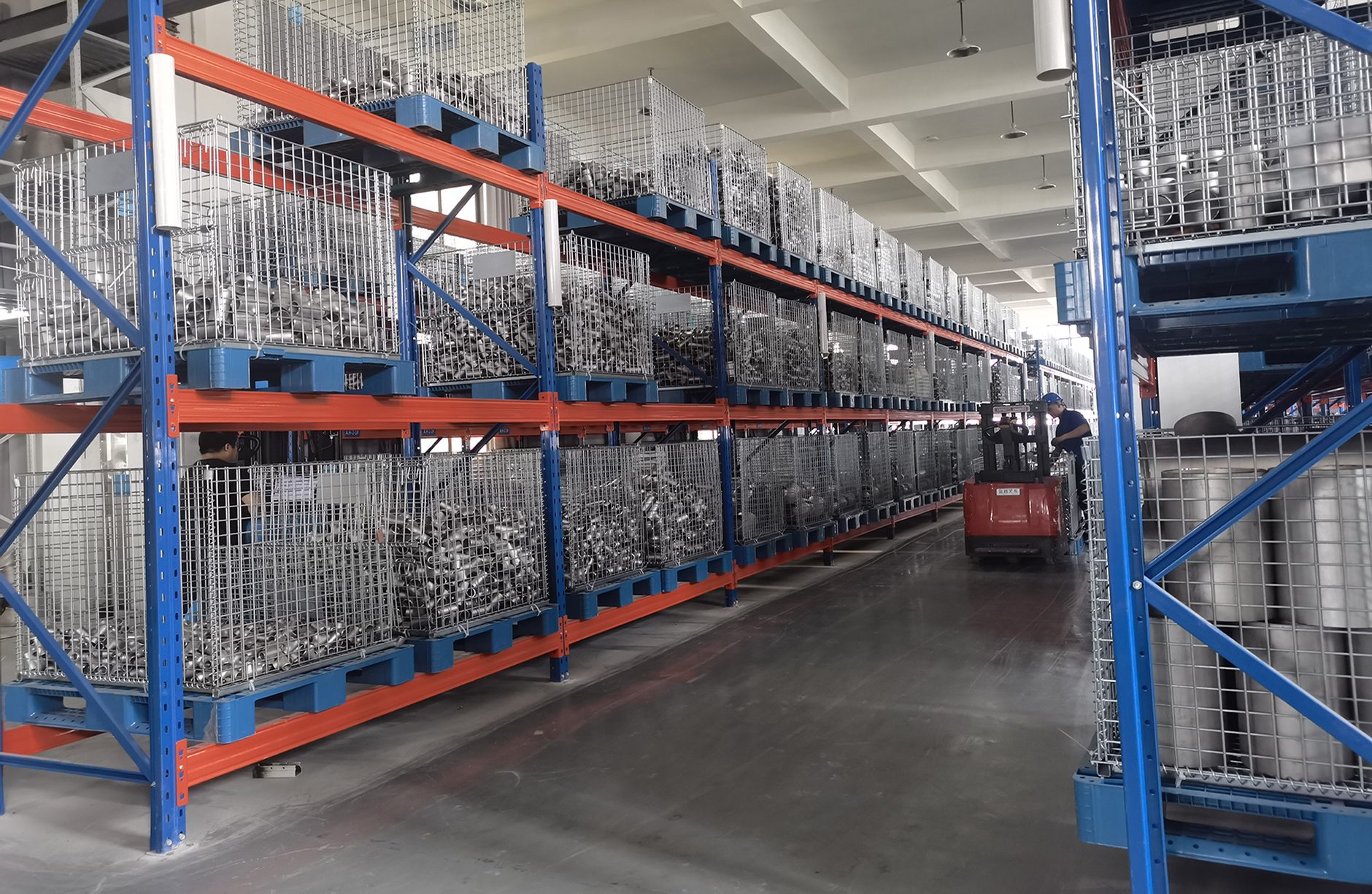
For suppliers, timely inventory preparation and delivery are very important, as is production flexibility. From the perspective of facilitating transactions, a supplier that can cover DN15–DN2000 sizes and Flange Class 150–2500 / PN10–PN160, deliver samples within 3–5 days and bulk orders within 30–60 days*, with a stock of 30 million pieces and an annual production capacity of over 2 million units*, would be a good partner.
*ZHIJU PIPE policy — confirm the current figure at the time of enquiry.
*Figures published on zhiju-steel.com, October 2026.
You may have come across such suppliers, fully qualified and with complete certifications.
However, their certificates do not withstand careful scrutiny. If the product sits outside the certified scope, or the certificate has expired, record it as a non-conformance and ask for a written explanation.
Regulations, dimensional standards and material standards are often listed side by side. They do not govern the same thing, and the table below separates them.
| Category | Standard / regulation | What it covers | Applies to | Common misunderstanding |
| Material | ASTM A240 | Chemical composition and mechanical properties of plate and strip | Plate flanges (A240 Type 316) | Assumed to be interchangeable with A182 |
| Material | ASTM A182 | Material requirements for forgings (flanges, forged fittings) | Forged flanges, A182 F316L | Assumed to be a dimensional standard |
| Material | ASTM A403 | Wrought austenitic stainless steel fittings | Butt-weld elbows, tees, reducers | Assumed to cover flanges |
| Material | ASTM A815 | Duplex stainless steel fittings | 2205 / 2507 fittings | Frequently left off the enquiry |
| Dimensions | ASME B16.9 | Dimensions and tolerances of butt-weld fittings | Elbows, tees, reducers, caps | Assumed to specify material |
| Dimensions | ASME B16.5 | Flange dimensions, pressure–temperature ratings, facings, marking | NPS 1/2″–24″ flanges | Assumed to require forging |
| Dimensions | EN 1092-1 / DIN / JIS B2220 | European / German / Japanese flange dimensions and drilling | Flanges to those systems | Assumed interchangeable at the same DN/PN |
| Documentation | EN 10204 | Type of material document (3.1 / 3.2) | Material certificates for pressure components | Assumed 3.1 includes third-party witnessing |
| Regulation | PED 2014/68/EU | Market access for pressure equipment entering the EU | Pressure fittings and flanges | Assumed ISO 9001 can substitute for it |
| Industry code | ASME B31.3 | Design, materials and construction of process piping | Chemical and petrochemical process piping | Assumed to be a product standard |
| Industry code | NACE MR0175 / ISO 15156 | Material requirements for H₂S stress corrosion | Sour oil and gas service | Frequently not asked about |
| Industry code | NORSOK M-650 | Manufacturer qualification | Suppliers to Norwegian oil and gas projects | Confused with M-001 (material selection) |
The true challenges for a factory are three things: large diameter, thick walls, and special materials.
Large diameters are not something anyone can handle: segments of DN2000 require hot pressing, which needs the appropriate technical expertise and production qualifications. Special materials: duplex steel S31803 (2205) and S32750 (2507) — the forming windows are much narrower than those of 304. The gap between manufacturers shows up in both price and risk.
Ask your supplier whether they have their own moulds, where the large sizes are produced, and whether they have experience with the same material.
Before anything ships, ask for these. That is the whole rule — before, not after.
Material test certificate, EN 10204 3.1 or 3.2, with a number you can trace to the heat. Dimensional report — and you want measured wall thickness, not the phrase “complies with standard.” NDT report, PT / UT / RT, and read the sampling ratio and the acceptance criteria, because a report that says “tested” without either is not a report. Surface roughness record with the measured Ra stated, if you are in hygienic service. Pickling, passivation and packing record.
Then the question that sorts suppliers faster than any other: do these travel with the goods, or do they get patched together afterwards?
A report produced after dispatch tells you nothing about the goods. Ask for the documents to travel with the shipment.
And ask whether they will accept third-party re-inspection, or a visit to the factory. Most will say yes. The ones who hesitate have told you something.
Everything above, in one list. Copy it. Send it to every supplier you are comparing, and compare the answers side by side rather than the prices.
| # | What to ask | What a good answer looks like | Red flags |
| 1 | Are you a factory or a trading company? | Business licence scope includes “manufacturing,” and they will send the original | Brochures only, and the question gets dodged |
| 2 | Can I see the workshop live? | Video on the spot, camera pointed where you tell them | Only a polished promo film |
| 3 | Is the material certificate 3.1 or 3.2? | Can issue 3.2 on request, and can explain the difference | 3.1 only, or cannot explain the difference |
| 4 | Can the certificate number be traced to the heat? | One item one code, traceable down to a single piece | Batch number only, no per-piece trace |
| 5 | How is wall thickness tolerance specified? | A concrete number, with measured values attached | “Complies with ASME B16.9,” full stop |
| 6 | How do you verify the finished goods before dispatch? | Measured values — dimensions, wall thickness, bevel — recorded per batch | “It complies with the standard” |
| 7 | How many standard sizes are in stock? | A specific figure | “Plenty of stock” |
| 8 | MOQ and lead time? | A range, with the factors that shift it | Same price and same lead time for every size |
| 9 | Does the certification scope cover this product? | Will send the certificate so you can check the scope | A wall of logos, nothing else |
| 10 | Do you have PED for Europe? | PED in place, backed by EN 10204 | “We have ISO, that is enough” |
| 11 | Do reports ship with the goods or follow later? | With the goods, or before dispatch | “We ship first, reports follow” |
| 12 | Can I get samples first? | Small batch or sample orders supported | Bulk minimum only |

Send the 12-line checklist to every supplier you are shortlisting, including us. The comparison is in the answers, not in the price column.
Q1. What is the practical difference between a factory and a trading company here?
Control over the process. A factory can change a non-standard dimension, adjust the tooling, and trace one item to one heat.
Q2. When do I actually need EN 10204 3.2 instead of 3.1?
When the consequence of a wrong material is high — toxic or flammable service, nuclear, or pressure components going into the EU.
Q3. How do I check the wall thickness I actually received?
By asking where the wall was measured — on a formed bend, the outer arc is where the wall thins most — and by matching the heat number on the markings to the MTR. A certificate alone will not tell you.
Q4. Which certification should I check first for Europe?
PED 2014/68/EU, together with EN 10204 material documentation. Check the scope on the certificate, not the logo.

THE QUALITY IS THE SOUL OF AN ENTERPRISE
Zhejiang Zhiju Pipeline Industry Co., Ltd
Official Website: https://www.zhiju-steel.com
Privacy Policy
Copyright ZHEJIANG ZHIJU PIPELINE INDUSTRY CO., LTD SUPPORT BY :JUNJ
 Optimized by Seraphinite Accelerator