- Whatsapp: 8618958900507
- Email: [email protected]


In chemical production, maritime waterway transportation, and industrial circulation pipelines, there’ve always been problems with fluid noise and continuous vibration. This has been a common pain point in pipeline operation and maintenance. A lot of engineering teams just deal with the noise problem by wrapping the pipelines with sound – insulating materials and installing shock – absorbing brackets. But these methods can only weaken the noise transmission. They solve the surface symptoms, not the root cause, and can’t get rid of the noise caused by the fluid turning at the source.
Pipe elbows are the core parts responsible for turning in the pipeline system and directly affect the flow state of the fluid inside the pipeline. The common short – radius right – angle elbows cause the fluid to make a sudden and sharp turn, creating a lot of chaotic turbulence and pressure fluctuations, which lead to continuous vibration and noise in the whole pipeline. This article combines the research on fluid – solid coupling vibration in authoritative journals. It explains the noise – generation principle of traditional elbows in an easy – to – understand way, explores the noise – reduction advantages of stainless – steel curved elbows, summarizes practical standards for choosing high – quality curved elbows, and shares the complete noise – reduction renovation process for 90 – degree elbow pipelines. It provides a directly implementable reference solution for pipeline designers and on – site construction workers to help upgrade the pipelines to low – noise ones.
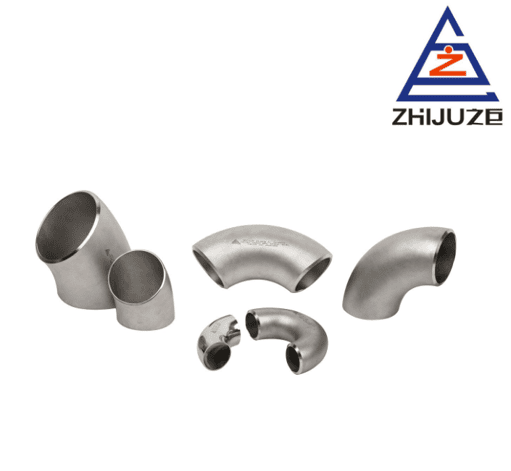
The reason why ordinary elbows generate a lot of noise is that the fluid turns too abruptly. When the fluid suddenly changes direction from a smooth – flowing state, the originally stable laminar flow gets disrupted, which causes turbulence noise and pipeline structure vibration problems.
The traditional short – radius stainless 90 – degree elbow is a rigid right – angle transition structure. When the fluid passes through the elbow at high speed, large – area vortices are generated on the inner and outer walls of the pipe, and the kinetic energy of the fluid is directly converted into continuous noise.
The commonly used 3/8 – inch, 3/4 – inch, and 4 – inch 90 – degree elbows are suitable for most small and medium – sized industrial pipelines, but they haven’t been optimized into an arc structure. During operation, the eddy – current noise is very obvious. For the 1 – 1/4 – inch and 3 – inch medium – and large – diameter elbows, because of their larger cross – sectional area, the eddy – current coverage is wider, and the overall noise decibel value goes up even further.
Apart from the audible turbulence noise, the hard right – angle stainless – steel elbows also transfer the fluid’s impact force to the whole pipeline support system. The continuous impact of the fluid at the elbow transition position generates a periodic force, which causes the pipeline to vibrate and make noise.
If the wall thickness of the elbow doesn’t match that of the main pipeline, the vibration will be superimposed and amplified, intensifying the pipeline resonance. As time goes by, not only will the noise get worse, but it’ll also speed up the aging and fatigue of the pipeline, increasing the frequency of subsequent maintenance and replacement. Relevant pipeline dynamics research also confirms that the sudden change in the pipeline’s geometric shape is the core cause of excessive pipeline vibration and noise.
The curved elbows designed specifically to solve the pipeline noise problem use a longer and rounder bending structure, which fundamentally optimizes the flow field inside the pipeline and effectively improves the pipeline vibration and noise problems. The specific noise – reduction principles are as follows:
Different from the rigid right – angle elbows, the large – radius curved elbows lengthen the turning path of the fluid. The fluid can turn smoothly and steadily, avoiding a sudden change in direction, thus completely eliminating the large – area vortex region inside the pipeline.
Combined with the smooth inner – wall process, the frictional resistance of the fluid is significantly reduced. Compared with traditional elbows, the pressure fluctuation amplitude is reduced by more than 60%. Fluid simulation data also prove that curved elbows can make the flow – velocity distribution more uniform, avoiding high – speed impact of the fluid on the pipe wall, and thus eliminating the turbulence noise in the noise source.
A smooth curved surface can evenly distribute the fluid impact force across the entire surface of the elbow, while a right – angled elbow will cause the pressure to concentrate in a single position.
Once the external force is evenly distributed, the periodic vibration force transmitted to the pipeline and the support structure will be significantly reduced, thus effectively suppressing the pipeline resonance. Meanwhile, the smooth inner wall weakens the coupled vibration between the fluid and the pipe wall and cuts off the propagation path of vibration noise in the entire pipeline, achieving a stable noise and vibration reduction effect.
To get the ideal noise reduction in the pipes, don’t just pick an elbow randomly. I’ve sorted out a clear and useful selection rule to help you quickly compare the parameters and precisely match the working conditions. This way, you can avoid using the wrong parts that don’t meet the noise reduction standards.
When replacing the noise-reducing elbow, its diameter has to be exactly the same as the original pipe.
If the sizes don’t match, there’ll be a throttling dead zone at the pipe joint, which’ll affect the water and air flow and create new noise.
The common specifications have a wide range: 3/8 inch and 3/4 inch are mainly for small instrument pipes; 1-1/4 inch and 3 inches are good for regular process pipes; and the 4-inch elbow is suitable for large-diameter main water supply pipes. Also, the wall thickness of the stainless steel elbow has to be the same as the main pipe to prevent vibration stacking due to inconsistent thickness and reduce the resonance noise of the pipes.
We summarize radius selection criteria by flow velocity in the following table:
| Pipeline Working Condition | Recommended Arc Radius | Noise Reduction Effect |
| Low flow rate (≤1.5m/s) | 1.0 times pipe diameter | Basic noise suppression |
| Medium flow rate (1.5–3m/s) | 1.5 times pipe diameter | Balanced space & silencing performance |
| High flow rate (>3m/s) | 2.0 times pipe diameter | Maximum vortex elimination |

Just swapping out the elbows ain’t enough if you want long – term, stable noise reduction without any bounce – back. You gotta do a systematic upgrade following the whole standardized process. For 90 – degree stainless – steel elbows in the pipe, the main steps for noise – reduction work are to remove the old parts and install new curved elbows.
First, shut down the fluid equipment to release the pressure inside the pipe, empty all the media in the pipe, and make sure the construction is safe.
Mark the cutting positions on both sides of the old elbow, leaving enough space for the new pipe elbow to be welded precisely.
Cut off the old right – angled elbow, clean up the remaining welds, and smooth out all the bumps and burrs on the pipe wall to keep the fluid flowing smoothly.
Totally get rid of the welding slag, oxide scale, and all kinds of deposits on the inner wall of the pipe. This stops impurities from causing secondary eddies and creating new noise problems.
Adjust the position of the new curved elbow accurately to make sure the central axis of the pipe is perfectly aligned. This avoids fluid chaos and local noise caused by installation errors.
Use full – penetration welding technology. After welding, sand the inner weld to ensure the curve of the elbow is smooth and continuous.
Add elastic pipe supports on both sides of the new elbow to block the transmission of residual vibrations and further reduce noise.
After installation, start the equipment for a trial run. Check the noise decibel level and vibration amplitude at the elbow. If there’s still obvious noise, you can add shock – absorbing pads to improve the effect.
Can just changing the old elbow to a curved one completely get rid of pipe noise?
Changing to a curved elbow can solve the eddy – current noise at the pipe elbow at the root. But if the pipe vibration and noise are caused by the resonance of equipment like pumps and compressors, you need to use shock – absorbing supports for extra optimization. Well – sized stainless – steel elbows can significantly cut down on the noise from the fluid. But you gotta do a full acoustic assessment of the whole pipe system before the upgrade. ZHIJU can customize the parameters of the curved elbow according to different pipe operating conditions and do fluid simulation tests in advance to ensure the upgrade works.
Will a large – radius curved elbow increase the pipe pressure loss?
Nah. A smooth and gentle curved elbow has less flow resistance than a right – angled one. As long as the pipe diameter, radius, and design flow are precisely matched, the pipe pressure loss won’t go up, and neither will the energy consumption. Some pipe systems can even save a bit of energy.
Can this noise – reducing curved elbow be used in pipes for transporting sanitary media?
Sure. This mirror – polished stainless – steel curved elbow meets the sanitary standards for food transportation and seawater desalination. The inner wall is smooth with no dead corners, so it won’t accumulate media. It’s totally suitable for noise – reduction upgrade projects of sanitary – grade pipes.
In fluid pipeline systems, traditional 90-degree stainless steel elbows are the main cause of pipeline operation noise. This is because of the sudden change in fluid direction and the sharp alteration of the flow field. Special noise-reducing curved elbow fittings can optimize the fluid state inside the pipeline and suppress the vibration of the pipeline structure, thus solving the noise problem from two aspects simultaneously.
This article elaborates on the two noise-reducing principles of curved elbows in detail, and summarizes the precise selection criteria for size and radius of curvature. It helps you choose the most suitable elbow according to the actual working conditions and effectively reduce the pipeline operation noise. Meanwhile, the article comprehensively reviews the noise-reducing renovation process of 90-degree elbow pipelines, truly achieving the goal of improving pipeline vibration and reducing operation noise by using curved stainless-steel elbows.
From noise problem analysis, elbow specification selection, to on-site disassembly, installation and welding construction, every link directly affects the final noise-reducing effect. Only by choosing the right stainless steel elbow fittings and combining them with standardized construction techniques can the pipeline system maintain a low-noise and stable operation state in the long run.
ZHIJU‘s full range of noise-reducing curved elbows covers all mainstream specifications from 3/8 inches to 4 inches, and is equipped with mature customized renovation solutions. It can efficiently solve various pipeline fluid noise problems in industries such as chemical engineering, marine engineering and water treatment.
If your project requires customized curved elbows, pipeline noise simulation analysis or on-site renovation technical guidance, feel free to consult our professional engineering team to get an exclusive one-on-one overall pipeline noise-reducing solution.

THE QUALITY IS THE SOUL OF AN ENTERPRISE
Zhejiang Zhiju Pipeline Industry Co., Ltd
Official Website: https://www.zhiju-steel.com
Privacy Policy
Copyright ZHEJIANG ZHIJU PIPELINE INDUSTRY CO., LTD SUPPORT BY :JUNJ
 Optimized by Seraphinite Accelerator