- Whatsapp: 8618958900507
- Email: [email protected]


When purchasing elbows, you usually run into this question: there are so many types, so which one is best? First, be clear on the elbow’s four key attributes: angle, radius, forming method, and material. These four decide the elbow’s scope of use. In other words, “there is no single best option, only the one that best matches your working conditions.”
Before you place your order, give your supplier these five items: angle, radius, NPS, wall thickness, and material plus end form. They will tell you the best option. Here is how you should prepare your procurement plan.


There are three common elbow angles: 90°, 45° and 180°. A 90° elbow is the most common way to turn a line through a right angle. A 45° elbow gives a gradual change of direction, which lowers pressure drop and erosion. 180° return bends are used in heat exchangers, compact layouts and coil piping.
| Angle | Typical duty | Flow effect | Where you usually see it |
| 90° elbow | Change direction by a right angle | Largest local pressure drop of the three; higher erosion on the outer arc | Process lines, headers, rack piping |
| 45° elbow | Change direction gradually, or offset a line | Lower pressure drop than a single 90°; often used in pairs | Long straight runs, drainage, offset layouts |
| 180° return bend | Reverse flow direction completely | Highest total loss; keeps a compact footprint | Heat exchangers, coils, jacketed lines |
Pressure drop is a function of the whole system, not the elbow alone — treat this as a comparison only, and confirm with your piping design.
Unlike other fittings, elbows are split into long radius (LR) and short radius (SR). The center-to-end distance of a long-radius elbow is 1.5 × NPS; for a short-radius elbow it is 1.0 × NPS. This is the dimension set by ASME B16.9.
The radius does not change what the elbow does — only how hard it works against the flow.
On a long-radius elbow, the outer arc thins less during forming, so it holds up better against pressure and flow erosion, and it will usually pass a cleaning pig. A short-radius elbow saves installation space, but it brings a larger pressure drop and more severe erosion on the outer arc. ASME B31.1 places stricter limits on the use of short-radius elbows in power piping.
So if space allows and you want a longer-lasting line, choose LR. If your installation space is tight, choose SR.
The forming method determines how uniform the wall thickness stays and how much the outer arc thins. In general there are three forming methods, each giving a different product: cold forming, induction bending, and segmented hot press. For large-diameter elbows, ZHIJU uses segmented hot pressing followed by solution annealing to remove internal stress. Smaller elbows are produced by a combination of cold forming and induction bending.
The outer arc (extrados) of an elbow is where the wall is thinnest; ASME B16.9 allows the minimum wall thickness at any point to be 87.5% of the nominal wall thickness.
Elbows come in different materials, and each material maps to its own standard. The table below separates what each standard actually covers, and clears up the common misconceptions*.
| Category | Standard | What it covers | Common misunderstanding |
| Material | ASTM A403 | Wrought austenitic stainless fittings (TP304L / 316L / 310) | Assumed to set dimensions |
| Material | ASTM A815 | Duplex stainless fittings (2205 / 2507) | Frequently left off the enquiry |
| Dimensions | ASME B16.9 | Elbow dimensions and tolerances: angle, radius, wall, bevel | Assumed to specify material |
| Documentation | EN 10204 | Type of material certificate (3.1 / 3.2) | Assumed 3.1 includes third-party witnessing |
*This table lists only the parts of the relevant standards that apply to elbows, for reference.
When you buy elbows, you cannot size them by nominal size alone. The elbow must share the same NPS and the same wall-thickness schedule (Sch 5S / 10S / 40S and so on) as the pipe it joins, and both ends of the elbow and the pipe must have matching butt-weld bevels. An elbow only works when it fits the fittings around it. Before you place the order, confirm the bore, wall thickness and bevel with your supplier.
Once the elbows reach the site, acceptance inspection can begin. There are three checks.
*per ASME B16.9
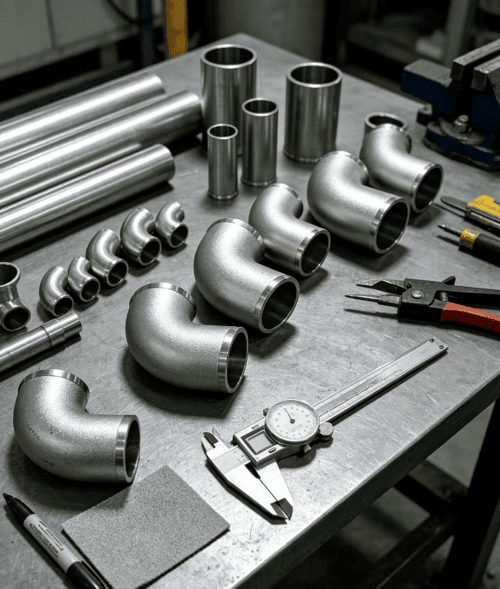
After reading the above, you should have a clear idea of what to watch for when buying elbows. Here is a checklist for quick reference.
| # | What to ask | What a good answer looks like | Weak signals |
| 1 | Which angle, and is it LR or SR? | States 90°/45°/180° and the radius (1.5 × NPS / 1.0 × NPS) without prompting | “Standard elbow”, no radius given |
| 2 | How is the elbow formed for this size? | Cold forming / induction bending / segmented hot press, stated per size | No answer on forming method |
| 3 | What material standard and grade? | A403 TP316L, with heat number | Only a grade, no standard number |
| 4 | NPS and wall schedule, matched to the pipe? | Confirms NPS, schedule and bevel end to your pipe | Sizes from NPS alone |
| 5 | Is the outer-arc wall thickness verified? | Measured values on the extrados, per batch | “Complies with B16.9”, nothing more |
| 6 | Marking and heat number traceable? | Shows a sample marking photo; heat traces to MTR | Paint marking only, no stamp |
Send us the angle, radius, NPS, wall schedule and material for each elbow on your list. We will confirm the forming method and lead time for each line.
Q1. Is a long radius elbow always the better choice?
In most process lines, yes — lower pressure drop, less erosion, and it usually passes a cleaning pig. A short radius elbow is chosen only where space forces it, and it is a decision your piping code has to allow.
Q2. What is the difference between a 90° and a 45° elbow in terms of pressure drop?
A 90° elbow imposes a larger local loss than a 45° elbow. That is why 45° elbows are often used in pairs for offsets. The effect on the whole system has to be confirmed in the design, not read off the elbow alone.
Q3. Can I order an elbow by angle and NPS alone?
No. Add the radius (long or short), the wall schedule, the material grade, and whether the ends are butt-weld bevels. Those four items are what decide whether the elbow matches your pipe.
Q4. How can I tell if an elbow was segmented and welded rather than formed from one piece?
Look at the inside and outside surfaces for longitudinal weld seams, and check the wall thickness around the outer arc. The certificate and the forming method should also be stated by the supplier for your size.

THE QUALITY IS THE SOUL OF AN ENTERPRISE
Zhejiang Zhiju Pipeline Industry Co., Ltd
Official Website: https://www.zhiju-steel.com
Privacy Policy
Copyright ZHEJIANG ZHIJU PIPELINE INDUSTRY CO., LTD SUPPORT BY :JUNJ
 Optimized by Seraphinite Accelerator