- Whatsapp: 8618958900507
- Email: [email protected]


Before you place an order for flanges, there are 8 things you should pay attention to. These eight items are what a complete flange RFQ needs. Leaving one out is the usual cause of “it fits but it leaks”.
Forging or cut from plate?
Design temperature corresponding to pressure rating
Seal surface type and roughness
Should the material standard be A182 or A240?
Standards and drilling system to be implemented
Bore and wall thickness
Marking and heat number
Transportation protection of sealing surfaces
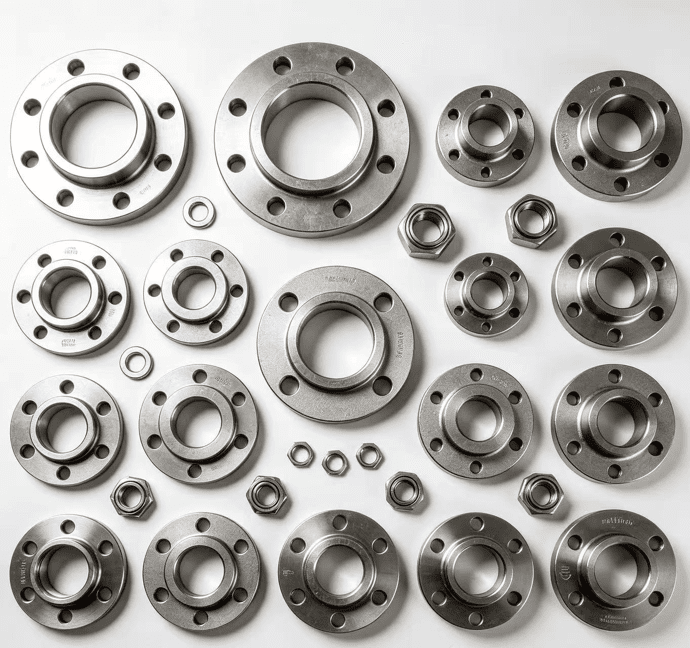
There are three ways to make flanges, corresponding to three different processes: solid forging (ASTM A182), die forging, and plate cutting (ASTM A240 plate).
The products of the three processes look almost the same, they can all be drilled, and they can all have a sealing surface machined. Once installed, they cannot be told apart.
But the big difference is inside them: forged metal has continuous flow lines that follow the shape; cut plate flow lines follow the original rolling direction of the plate and may have inclusions and layering.
Plate flanges are cheap, but they have lower fatigue resistance, impact toughness, and pressure capacity. They are usually used in low-pressure public works, circulating water systems, HVAC, fire sprinkler loops, atmospheric tanks, structural connections, and extra-large diameter projects.
Whether plate is acceptable depends on the applicable piping code and your project specification. ASME B31.3 process piping normally specifies forged flanges to ASTM A182.
ZHIJU produces both forged flanges (WN, SO, BL) and plate flanges (PL), so the process question can be answered against a specific duty. Before you place an order, confirm the intended use with your supplier and select the appropriate process to avoid major troubles that may arise later.
Class is a rating designation, not a pressure value. A Class 300 flange does not carry the same allowable pressure at 38 °C and at 200 °C. When you are buying flanges, writing Class 300 on the enquiry is not enough on its own; the design temperature and design pressure need to go with it.
At the same time, the material of the steel also determines the allowed pressure. For example, 304 and 316L have very different allowable pressures at high temperatures.
Three rows from the Class 300 pressure-temperature tables, to show how much one Class number hides:
| Material group (ASME B16.5) | Representative forging | Class 300 at 38 °C (100 °F) | Class 300 at 400 °F (204 °C) |
| Group 1.1 | ASTM A105 (carbon steel) | 740 psig | 635 psig |
| Group 2.1 | ASTM A182 F304 | 720 psig | 495 psig |
| Group 2.2 | ASTM A182 F316 | 720 psig | 515 psig |
Example values from the ASME B16.5 pressure-temperature tables, Class 300. Ratings are revised between editions and group assignments change with them: check the current edition of B16.5 before using any figure, and confirm which material group your grade falls in. Where the standard permits, values between listed temperatures are interpolated.
Before you place an order, give your design pressure and design temperature to the supplier so they can pick the right product for you.
The sealing surface is the part of the entire flange workpiece that actually functions. However, it is often overlooked. Generally, flanges have 3 types of sealing surfaces: RF / FF / RTJ.
RF is the most commonly used sealing surface, while FF is used with cast iron or brittle materials. RTJ is different, as it needs to withstand high temperature, high pressure and acidic working conditions.
There are also requirements for roughness. The RF surface needs to be in the Ra 3.2–6.3 μm range.
When you receive your purchase, check the sealing surface for scratches, rust spots, welding slag or remnants of old gaskets as soon as you unpack. Any of these is a leak path.
Material and manufacturing method are two sides of the same coin. Take A182 F316L and A240 Type 316 for example. The composition limits are close, but they are different specifications; what matters on the MTR is the standard number. So when looking at MTRs, you should not stop at the composition. If it says A182, it is a forged part; if it says A240, it is a plate.
Here are the standard flange materials for your reference: A182 (forged, stainless steel / alloy), A240 (plate). For fittings, it is A403 (austenitic), A815 (duplex).
ZHIJU data: our flange range covers Class 150–2500 / PN10–PN160, in TP304L / 316L / 310 / duplex 2205 and super duplex 2507 — confirm the current range at the time of enquiry.
Before you place an order, ask your supplier for the original MTR and check if the standard number, heat number and grade match.
Different dimensional standards are not interchangeable at the same nominal size. Products made in line with different standards are completely distinct from one another, and it cannot be identified by measuring the bore. Customers come to inquire with old drawings, and it is impossible to determine the product based on DN and PN alone — this is very common in spare parts procurement.
The sizes look about the same, but the bolt circle diameter, number of holes, hole size, and outer diameter for ASME B16.5, EN 1092-1, DIN, and JIS B2220 are all different.
Two different standard flanges with the same nominal size do not line up on the bolt holes. If you try to force the bolts on site, the preload gets lost and leakage during the pressure test becomes likely. When refurbishing old equipment and purchasing spare parts, the drawing says DN200 PN16, but the warehouse gives you 8″ Class 150, which does not fit.
Give the supplier your flange standard, pressure rating and seal face type, and include the actual measurements and photos so everyone is clear.

If you are purchasing a weld neck flange, additional checks apply. The bore of the weld neck flange has to match the inner diameter of the pipe and cannot be selected according to the nominal size alone.
If the bore is incorrect, welding will rely on grinding, or a boss may be left, causing turbulence and erosion. Provide your required outer diameter, wall thickness, or pipe schedule to the supplier, rather than just an NPS. We use weld neck flanges for their strong fatigue resistance — not because they are thicker, but because of a more uniform stress distribution.
You have completed your purchase, and now it is a matter of what to do after the goods arrive. Proper closure is also crucial. You need to inspect:
Marking: among the marking items required by ASME B16.5, procurement should at least verify the manufacturer, material grade, NPS, pressure rating and heat number. If the marking is rubbed off, and there is only paint without a steel stamp, traceability is weakened.
Traceability: the heat number has to follow the piece to the MTR.
Seal face protection: this is an often-overlooked aspect. When flanges are jostled inside containers for several days, the seal faces may collide with each other or come into contact with carbon steel components — the free iron from the carbon steel can rust on the stainless steel surface, and when customers open the container and see the rust spots, their first reaction is that the material is incorrect.
These three rarely decide a flange order on their own, and they are where the last disagreements tend to sit.
Quantity. For standard flanges in common sizes, a small quantity is usually not a problem — stock covers it. The number that matters is not the minimum order quantity in the catalogue; it is whether the size you need is a stock item or a production item. A DN80 Class 150 flange in a standard material may ship from stock. The same flange in 2507, or with non-standard drilling, or above the usual size range, is a production item, and both the lead time and the minimum quantity move with it. Ask which category each line of your list falls into — a flange order is often a mixed list, not one item.
Lead time. A flange lead time is built from three blocks: whether raw material has to be bought for that material grade, how long the facing and the drilling take, and how large the batch is. Drilling is usually the variable step: one hole pattern on a standard size is routine; a mixed batch carrying three drilling standards is not. If the flanges have to match a piping spool that is already being fabricated, give the supplier the spool schedule rather than a single date — it is often possible to sequence the batch so that the sizes needed first arrive first.
Packing. Flanges are heavy, and they are machined on both faces. Damage in transit usually happens on the sealing face, and it is usually caused by one of two things: flange faces striking each other, or stainless faces resting against carbon steel. Both are avoidable with the right packing — individual face covers, separators between pieces, and stainless kept away from carbon steel in the same case. If the flanges go into storage before installation, ask for packing that can be reopened and closed without the pieces shifting, with moisture protection that lasts.
What to put on the RFQ: quantity per size and pressure class, whether the batch may be split, the date each part of the batch is needed on site, and the packing method. Packing is rarely priced separately on a flange quotation, and it is the item most often changed at the last minute. If it matters, write it into the enquiry rather than leaving it to the shipping instruction.
| # | What to ask | What a good answer looks like | Weak signals |
| 1 | Forged (A182) or cut from plate (A240)? | States the process without hesitation | “Same thing” or avoids the question |
| 2 | Which pressure class at which design temperature? | Asks for your design P and T back | Accepts “Class 300” alone |
| 3 | Facing type and surface roughness? | Names RF/FF/RTJ and gives an Ra value | “Standard finish” |
| 4 | Material standard and grade on the MTR? | A182 F316L, with heat number | Only a grade, no standard number |
| 5 | Which dimensional standard and drilling? | Confirms the mating flange standard | “We can drill anything” |
| 6 | Bore matched to which pipe OD × WT? | Asks for your pipe schedule | Sizes from NPS alone |
| 7 | Marking and heat number traceable? | Shows a sample marking photo | Paint marking only, no stamp |
| 8 | How is the sealing face protected in transit? | Describes caps, separators, packing | No answer, or “wooden case” only |
| 9 | Quantity per size, and can the batch be split? | A per-size breakdown and a stated split policy | One number for the whole list |
| 10 | Is packing included, and how are the faces protected? | Face covers and separators described, packing in the price | “Packed for sea freight,” nothing more |
Send us your flange RFQ with design pressure, design temperature, dimensional standard and pipe schedule. We will confirm each line before we quote.
Q1. Where exactly does a plate flange get its price advantage?
Not in the machining — it is drilled and faced like any flange. It is in the steps before: no forging, and usually less testing and documentation behind the piece. That is also where the difference shows up in service.
Q2. Can I order by size and pressure class alone?
No. Add the design temperature, the dimensional standard, and pipe OD with wall thickness.
Q3. What do I check the moment the crate opens?
The sealing face — radial scratches running from the bore outward are leak paths. Then check that the marking is stamped rather than painted, and that the heat number matches the MTR.
Q4. Are plate flanges acceptable anywhere?
Yes — low-pressure utility, HVAC, fire mains, atmospheric tanks and structural connections. They are not normally accepted for ASME B31.3 process piping.



THE QUALITY IS THE SOUL OF AN ENTERPRISE
Zhejiang Zhiju Pipeline Industry Co., Ltd
Official Website: https://www.zhiju-steel.com
Privacy Policy
Copyright ZHEJIANG ZHIJU PIPELINE INDUSTRY CO., LTD SUPPORT BY :JUNJ
 Optimized by Seraphinite Accelerator