- Whatsapp: 8618958900507
- Email: [email protected]


To put it simply, weld neck flanges (WN) and blind flanges (BL) are not competing choices — they do different jobs and often appear on the same line. Use a weld neck flange to connect, a blind flange to close.
What takes real care is checking each one’s risk points. The WN’s sit in the bore and the weld; the BL’s sit in thickness, bolt load and pressure-test conditions. The seemingly simplest blind flange is in fact the type that carries the highest bending stress in B16.5.* The two are explained separately below.
*Per ASME B16.5 — the standard that sets flange dimensions and pressure–temperature ratings.
Start with the structure. A weld neck flange is a long tapered hub ending in a butt-weld end. The pipe is aligned to the end of the hub and joined by a full-penetration circumferential weld — once welded through, the pipe, the weld and the flange become one continuous piece. The inner wall stays flush: no step, no gap.

Sectional view of weld neck flange and blind flange
Both share the same flange outside diameter, bolt circle and bolting in a given size and class. They differ in how they join the pipe. Welds are shown in orange. Not to scale.
That flush, continuous path is why the weld neck flange handles stress well — it suits cyclic loading, pulsating flow, vibration and high temperature. And because the weld is a full-penetration butt weld, it can be inspected by radiography (RT).
ZHIJU data: our weld neck flanges are produced by integral forging, subject to the contract — confirm the current process at the time of enquiry.

Compared with a weld neck flange, a blind flange is a simple structure (see the figure above): a solid disc with no bore, bolted in place and not welded. It has two uses:
Many people think of blind flanges mainly as permanent closures. The second use is what makes them irreplaceable: they are removable and reusable — fit one for a pressure test, take it off when the test is done, and use it again at the next location. Blind flanges also show up at manways and inspection ports, drain and vent openings, and for lockout/tagout (LOTO) isolation — a blind gives visible physical isolation, which a closed valve does not.
A blind flange looks like the simplest flange — a solid disc with no bore — but simple in shape is not simple in duty. Pressure acts across the whole face of the disc with atmospheric pressure on the other side, so the full differential is carried by this one plate. A weld neck flange spreads stress into the pipe wall through its tapered hub; a blind flange has no hub and no bore, so it can only resist the bending moment through the thickness of the plate alone. For the same class and size, a blind flange therefore needs a greater plate thickness.
In practice, the blind flange is often the component sealing the line during a pressure test. That test is the highest-risk moment: the test pressure is typically about 1.5 times the design pressure (a common ASME B31.3 practice), yet a blind flange is often simply selected to match the line class, with no one checking it against the test conditions separately.
Before ordering a blind flange, pin down these three questions:
The pressure–temperature rating for a given material group and class comes from the same table for both types — the example below is Class 300.
| Material group (ASME B16.5) | Representative forging | Class 300 at 38 °C (100 °F) | Class 300 at 400 °F (204 °C) |
| Group 1.1 | ASTM A105 (carbon steel) | 740 psig | 635 psig |
| Group 2.1 | ASTM A182 F304 | 720 psig | 495 psig |
| Group 2.2 | ASTM A182 F316 | 720 psig | 515 psig |
Example values from ASME B16.5. Confirm against the current edition for your size, class and material group.
The table applies to both weld neck and blind flanges, but the load path is different: pressure on a WN is carried by the weld and the flange together, and problems mostly show up at the weld; pressure on a BL is carried by the plate thickness and bolt preload, and problems mostly show up at installation — faces not parallel, the wrong gasket, the wrong torque, scratches. So the two types are checked at completely different points.
A few more points are worth noting when selecting a weld neck flange. Its bore must match the pipe’s inner diameter — it cannot be chosen from NPS alone. Get this wrong and the delivered bore will not fit; the field then grinds it to suit or leaves a step, and that step causes local turbulence and erosion and can interfere with pigging and internal inspection. So when you send the RFQ, include five things: NPS + schedule (or measured OD × WT) + material (with the ASTM number) + class (with the design temperature) + facing type.
Sealing performance is the top priority for either type. The points below are the last mile to getting it right:
On piece price, a blind flange of the same size is usually cheaper than a weld neck flange — less material, fewer operations. The installed cost runs the other way: a WN needs certified welders, WPS/PQR, possibly PWHT and NDE, while a blind is simply bolted on, so the WN’s installed cost is significantly higher. One more point: a WN is a permanent connection — to remove it you cut it out — while a blind flange is reusable.
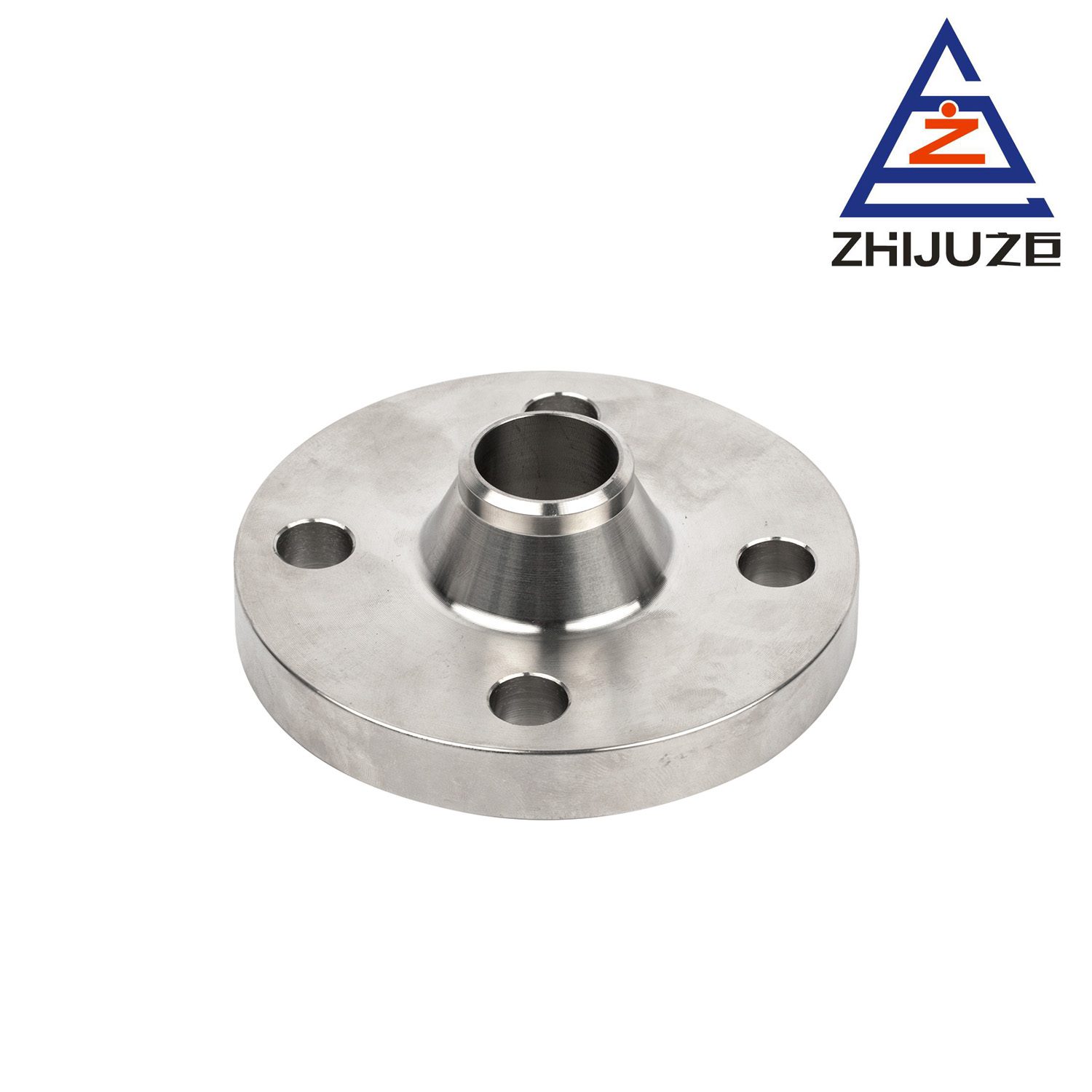
The table below is for quick reference on the differences between the two types.
| Weld Neck Flange (WN) | Blind Flange (BL) | |
| What it does | Connects pipe to pipe, valve or equipment | Closes or terminates the end of a line |
| Bore | Matches the pipe ID — continuous flow path | Solid — no bore |
| Connection | Butt welded, full penetration | Bolted only — no welding |
| Removable? | No — cutting required | Yes — removable and reusable |
| Stress pattern | Tapered hub spreads stress into the pipe wall | Full disc sees the highest bending stress of any flange type |
| Thickness | Per the B16.5 table | Generally thicker than a same-class WN — the plate carries the load alone |
| Where it fails | The weld | The bolted joint — gasket, torque, face condition |
| Installed cost | Significantly higher — welders, WPS/PQR, NDE | Lower — bolting only |
| Typical service | High pressure/temperature, cyclic load, pump and compressor nozzles | Line ends, maintenance isolation, hydrostatic testing, future tie-ins, manways |
Tell us what the flange has to do — connect or close — and the design temperature it works at. We will confirm the type, the bore and the facing against that duty before anything is quoted.
Q1. Can a blind flange be reused after a hydrostatic test?
Yes — that is one of its main advantages. It is bolted, not welded, so it can be removed and reinstalled. Two checks before reuse: the sealing face must be undamaged (look for radial scratches, pitting or old gasket residue), and the gasket must be new. A compressed gasket does not recover — reusing one is among the most common causes of a leak.
Q2. What can go wrong with a blind flange if it is ordered “by class”?
The class sets the bolted connection, not the plate. A blind sees the full line pressure across its whole face, so it is the flange most sensitive to how the thickness was selected — and the moment of highest risk is the hydrostatic test, where the pressure is above design. Ask specifically whether the thickness was verified against test conditions and whether the bolt load was calculated.
Q3. Why does a blind flange leak right after installation, even though it passed inspection?
Almost always the assembly, not the part. Typical causes: flange faces not parallel, a gasket that has been reused or is the wrong type, bolts tightened in sequence but without staged torque, or a sealing face with a radial scratch running from the bore outward — a ready-made leak path. None of these show up in an inspection report; they show up at start-up.

THE QUALITY IS THE SOUL OF AN ENTERPRISE
Zhejiang Zhiju Pipeline Industry Co., Ltd
Official Website: https://www.zhiju-steel.com
Privacy Policy
Copyright ZHEJIANG ZHIJU PIPELINE INDUSTRY CO., LTD SUPPORT BY :JUNJ
 Optimized by Seraphinite Accelerator