- Whatsapp: 8618958900507
- Email: [email protected]


In oil, chemical, marine and pharmaceutical piping systems, pipeline terminal sealing reliability directly determines overall operational safety. Many unplanned shutdowns and medium leakage incidents can be traced back to defective end caps whose pressure bearing capacity fails to match design standards. Raw material grade alone cannot guarantee stable long-term pressure performance; every forming, heat treatment and surface finishing step reshapes the mechanical structure of sealing components. This article centers on how processing technology affects butt weld pipe cap pressure resistance, systematically sorts core production variables, mainstream forming crafts and targeted optimization schemes. As core terminal sealing parts, Butt Weld Caps require strict process control to avoid hidden pressure failure risks.
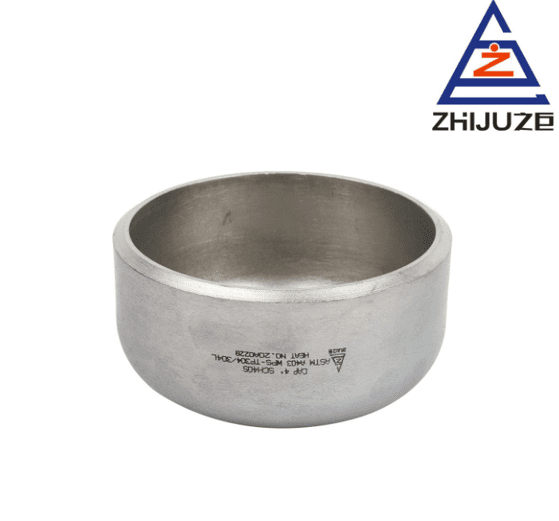
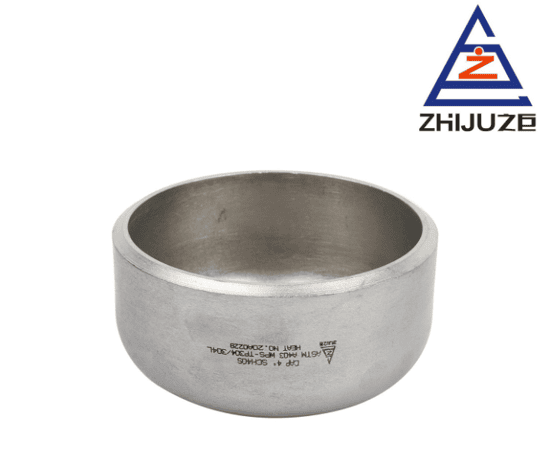
Standard steel buttweld caps are manufactured following ASME B16.9 specifications, adopting integral ellipsoidal or hemispherical curved heads with standardized welding bevels. Different from flat blind plates and threaded plugs, their smooth curved surfaces evenly disperse internal hydraulic stress without concentrated stress hotspots, so they can match the pressure rating of pipes with identical wall thickness. Wall specifications cover Sch40 to Sch16, with carbon steel blanks complying with ASTM A234 and stainless blanks following ASTM A403. Any uncontrolled forming parameter will create wall thinning, folds or residual stress on a butt weld pipe cap, greatly lowering its safe working pressure threshold.
Corrosive and sanitary pipelines widely adopt stainless buttweld caps, divided into two mainstream material grades differentiated by operating media:
304 stainless variants: Clean water circulation, low-concentration neutral chemical fluids and food production pipelines, requiring post-forming passivation to rebuild anti-corrosion passive film;
316L stainless variants: Offshore brine, high-chloride reaction media and high-temperature corrosive delivery loops, needing electropolishing to eliminate micro-pits on inner curved surfaces.
When analyzing factors influencing pressure tolerance of butt weld end cap during production, four core processing links dominate finished bearing performance:
Forming temperature fluctuation: Overheating leads to coarse metal grains, while insufficient heating triggers uneven wall thickness on the cap crown;
Mold matching defects: Rough mold inner walls or unreasonable fillet radii generate invisible stamping folds and microcracks;
Missing post-forming heat treatment: Unrelieved residual tensile stress overlaps with pipeline internal pressure, easily expanding into penetration cracks;
Rough machining and surface defects: Uneven bevel cutting creates localized stress concentration areas on a buttweld end cap.
Metal grain distribution and wall thickness uniformity are reshaped in each forming procedure. Standard hot stamping refines internal grains and improves material ductility, while unannealed cold forming causes severe work hardening, making the fitting brittle under alternating pressure loads. Even well-formed semi-finished products will lose partial pressure resistance if surface shot blasting and passivation are skipped; tiny surface corrosion pits gradually erode wall thickness during long service and trigger pressure failure of a weld end cap.
Three mature forming methods cover all specifications of end caps, with distinct pressure performance pros and cons sorted in the table below:
| Forming Craft | Applicable Sizes | Pressure Performance Characteristics |
| Hot stamping forming | NPS2–NPS48 large-size fittings | Uniform wall thickness, low residual stress, optimal for Class1500 high-pressure pipelines |
| Cold hydraulic forming | NPS1/2–NPS12 small-size fittings | High dimensional accuracy, mandatory solid solution annealing to avoid hardening brittleness |
| CNC spinning forming | Custom thin-wall sanitary caps | Smooth inner curved surface, no stamping folds, ideal for stainless sanitary lines |
Carbon steel weld on pipe caps steel generally adopts hot stamping plus normalized tempering as the standard production flow. Stainless blanks formed by cold hydraulic or spinning must complete solid solution heat treatment to eliminate cold work stress. Ultra-large-diameter caps unable to be integrally stamped adopt plate rolling and full penetration circumferential welding, which requires 100% RT radiographic inspection to eliminate internal weld defects that damage pressure bearing capacity. All semi-finished products need full wall thickness scanning to control thickness deviation within ±0.3mm.
To realize adjust craft to enhance pressure performance of weld on steel pipe caps, targeted optimization measures can be implemented against weak processing links:
Stabilize furnace temperature during hot forming, holding stainless blanks at 900–940℃ for fixed holding time to prevent grain coarsening;
Optimize mold fillet radius above 15mm and evenly spray high-temperature lubricant to eliminate stamping folds;
Mandatory post-forming annealing: Carbon steel held at 650℃, stainless steel at 880℃ with slow cooling to fully release residual stress;
Adopt integrated CNC bevel machining to guarantee consistent wall thickness at welding ends and avoid local thin walls.
Implementing processing tips to boost stainless buttweld caps bearing capacity is critical for pipelines with both corrosion and high-pressure requirements:
Complete solid solution treatment immediately after cold forming to eliminate work hardening stress inside stainless workpieces;
Conduct sequential 400#–1200# sanding followed by electropolishing for inner curved surfaces to remove micro-pits and corrosion initiation points;
Strictly separate carbon steel molds and fixtures during production to avoid iron contamination and subsequent pitting corrosion;
Arrange full passivation after all machining procedures to rebuild dense chromium anti-corrosion passive film.
These minor craft adjustments effectively prevent pressure failure caused by long-term surface corrosion thinning.

Systematic full-process upgrading can fully improve pressure resistance of steel buttweld caps via optimized processing:
Raw material incoming inspection: Complete PMI material identification and ultrasonic flaw detection to eliminate blanks with internal non-metallic inclusions;
Segmented slow pressurization during stamping to balance metal flow and prevent over-thinning of the cap crown wall;
Unify heat treatment holding time and cooling speed to ensure consistent mechanical properties across the entire cap body;
Full dimensional scanning after forming, directly scrapping semi-finished products exceeding wall thickness tolerance limits.
Standardized closed-loop control enables carbon steel end caps to stably reach their design Class pressure rating under long-term cyclic load.
Multi-layered inspection standards verify whether processing crafts meet pressure resistance requirements for finished butt weld end cap:
100% visual screening: Check the curved head for folds, deep scratches and impact indentations;
Full ultrasonic wall thickness scanning: Focus detection on the knuckle high-stress zone in accordance with ASME B16.9;
Nondestructive flaw detection: MT magnetic particle testing for surface microcracks, UT ultrasonic testing for internal forming defects;
Sampling hydrostatic test: Pressurize to 1.5 times nominal working pressure and hold for 30 minutes without weeping or permanent deformation.
Any unqualified item requires rework or direct scrapping to avoid hidden pipeline safety hazards.
Can cold-formed stainless butt weld end caps be directly used without heat treatment?
No. Cold forming creates severe work hardening and residual stress; without solid solution annealing, the fitting is prone to crack under alternating pressure.
What inspection must be carried out to confirm a butt weld pipe cap meets high-pressure standards?
Wall thickness scanning, MT/UT nondestructive testing and sampling hydrostatic test are mandatory for Class600 and above high-pressure fittings.
Which manufacturer provides full-process controlled butt weld caps with customized processing schemes for different pressure media?
ZHIJU supports one-stop customization of carbon and stainless steel end caps, providing targeted forming and heat treatment process optimization for high-pressure, corrosive pipeline working conditions.
Will stamping folds on the cap surface affect its long-term pressure resistance?
Yes. Folds form severe stress concentration zones, which will gradually expand into penetration cracks under repeated internal pressure impact.
This article systematically sorts the complete logic of processing craft optimization for end caps, starting from the structural characteristics of Butt Weld Caps, analyzing production variables that damage pressure bearing capacity, comparing mainstream forming technologies, and putting forward operable optimization schemes and standardized inspection norms. Whether carbon steel steel buttweld caps or corrosion-resistant stainless steel buttweld caps, their long-term pressure stability cannot rely solely on raw material quality; every link from blank heating, mold forming, heat treatment to surface finishing will change the actual bearing limit of the fitting. By strictly implementing the optimization methods mentioned in this article, enterprises can effectively reduce pipeline leakage risks caused by unqualified end caps and cut long-term maintenance costs. The core selection principle is to match forming and heat treatment crafts with medium corrosivity, operating pressure and temperature instead of blindly pursuing low-cost simplified processing.
ZHIJU has complete integrated production lines for all specifications of end caps, capable of formulating exclusive forming, heat treatment and surface finishing schemes according to different pipeline pressure and medium parameters. If you are sourcing standard or customized butt weld caps and need professional craft matching and pressure performance consultation, feel free to contact us for tailored technical support and detailed quotations.

THE QUALITY IS THE SOUL OF AN ENTERPRISE
Zhejiang Zhiju Pipeline Industry Co., Ltd
Official Website: https://www.zhiju-steel.com
Privacy Policy
Copyright ZHEJIAGN ZHIJU PIPELINE INDUSTRY Co.,Ltd SUPPORT BY :JUNJ