- Whatsapp: 8618958900507
- Email: [email protected]


Chemical processing pipelines transport corrosive solvents, slurry with particles, and sterile reaction fluids under different pressures and temperatures. The pump outlet, as the discharge point of pressurized fluid, completely relies on a well-matched transition component to stabilize the flow conditions. If the pipe reducer transition component is not sized appropriately, it will cause turbulence, excessive pressure drop, and cavitation, resulting in a 15% to 25% increase in the annual power consumption of the centrifugal pump, and accelerating the wear of seals and bearings. Unlike general industrial pipelines, chemical pipelines need to meet multiple important requirements such as corrosion resistance, hygiene standards, and fluid mechanics performance. This article provides a complete operational framework to help chemical engineers avoid costly size misjudgment problems during the design stage.
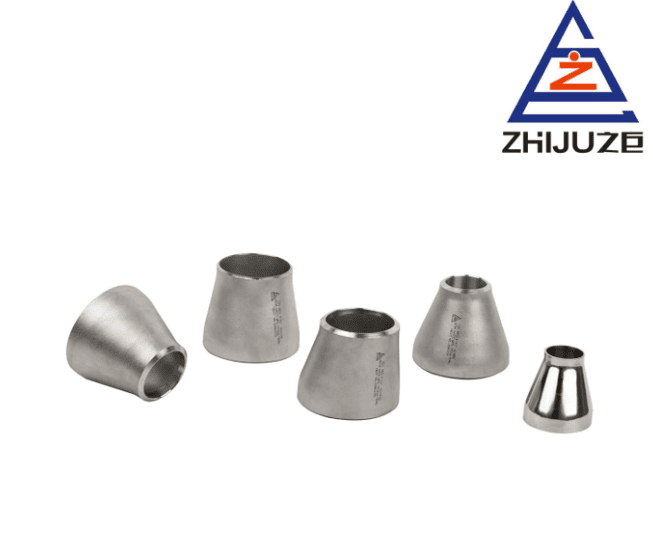
Industrial transition pipe fittings mainly adopt two basic geometric structures, but only concentric structures are suitable for pump outlet pipelines; eccentric types are specifically used for horizontal pump suction inlet pipelines.
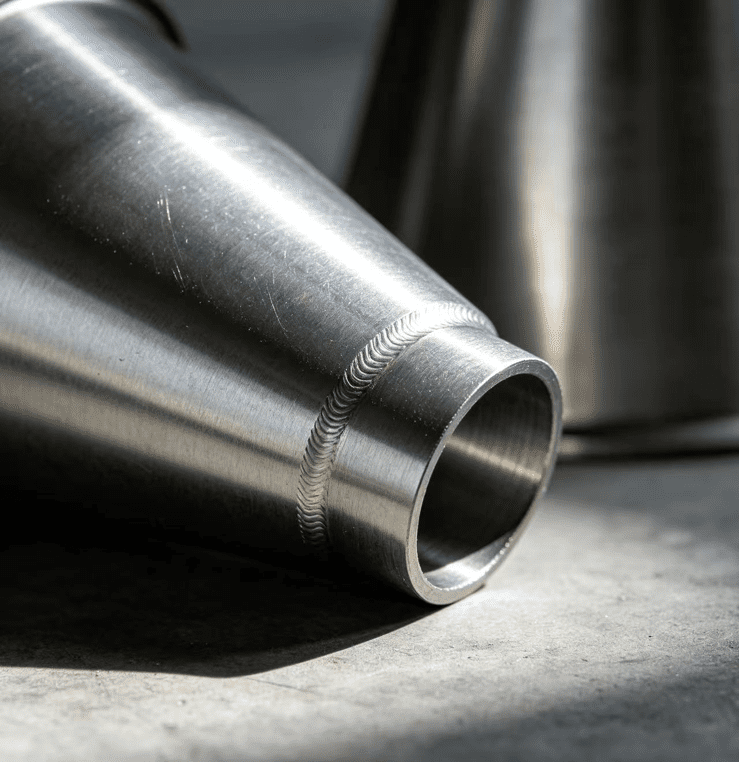
Stainless steel concentric pipe reducer adopts a symmetrical conical structure, with the center lines of both ends being perfectly aligned. Whether the large end or the small end can achieve good fit. Its inner conical surface evenly distributes the fluid velocity and pressure, does not generate local vortices, and is therefore the standard transition joint for vertical pumping pipelines. This pipe fitting is made of 304, 316L or duplex stainless steel alloys, resistant to corrosion in acidic and high chloride media, with an internal surface that can be polished, and complies with hygiene standards. Compared with similar carbon steel products, its service life is extended by 3 to 5 years in corrosive chemical conditions, with a pressure-bearing range of 0.6 MPa to 10 MPa.
Carbon steel version: Suitable for non-corrosive circulating water, low-pressure gas, and crude oil raw material pipelines, with cost advantages for less demanding chemical workshops;
Stainless steel version: Suitable for fine chemicals, pharmaceuticals, highly corrosive acids and bases, and sterile production circulation systems.
For all pump outlet layouts, concentric design is still the preferred option, while eccentric elbow connectors are prohibited here.
Matching only the nominal diameter value cannot guarantee stable operation; the specifications of stainless reducer need to be determined jointly by pipeline design standards and medium characteristics.
Chemical plant pipelines in the pump outlet transition section follow standardized hydraulic limitations:
Control the liquid flow velocity below 3 m/s to slow down the erosion corrosion of the inner conical wall;
Avoid a single step diameter reduction between more than three standard pipe diameters; large-span transitions need to be reduced in segments to suppress turbulence.
The wall thickness (grade) must be completely matched with the adjacent pipelines to ensure consistent pressure-bearing capacity and seamless connection of welding;
Directly install the steel concentric reducer next to the pump flange and reserve at least three times the pipe diameter straight pipe section to compensate for the fluid disturbance from valves or elbows.
Medium composition determines the material grade, internal surface treatment, and wall thickness.
| Medium Category | Recommended Fitting | Core Technical Requirement |
| Weak acid, low-chloride normal-temperature solvent | 304 pipe reducer stainless steel | Basic pickling passivation, no high-gloss polishing required |
| Strong acid, high-chloride fluid over 60°C | Duplex 2205 stainless concentric reducer | PREN value above 34 for anti-pitting performance |
| Aseptic pharmaceutical & high-purity chemical stock | sanitary concentric reducer | Electropolished inner surface Ra ≤ 0.4μm, no dead zones for CIP cleaning |
| Slurry containing solid particles | Thickened stainless concentric reducer | Extended taper length to reduce wall scouring |
According to hygiene requirements, Selection is divided into two main chemical scenarios, and specific specification standards have been formulated for each type of concentric transition joint.
The stainless cone reducer joint is another name for the symmetrical stainless steel concentric pipe fitting, which forms the core logic for selecting the appropriate stainless steel conical joint in chemical industry pipe connections:
Record the NPS/DN nominal size of the pump outlet and the downstream pipe size, and label it in the large end × small end format according to industrial practice;
Calculate the total pipe pressure drop; if the single-stage transition exceeds the allowable pressure drop threshold, it is divided into two stages of pressure reduction;
High-temperature and high-pressure pipes use butt welding connection; only in the low-pressure small-diameter pipe routes with an inner diameter less than 2, clamp or threaded end can be used.
Shorten the cone angle to below 15° to reduce the turbulent wear of the particle medium.
For biochemical and sterile drug production lines, operators should follow the recommendation of selecting a sanitary concentric reducer that matches the pump diameter:
Use pump-specific sanitary flanges that comply with DIN 11865 or 3-A standards, with unified connection dimensions to eliminate small gaps that may breed microorganisms;
Prefer seamless cold forming manufacturing over welding structures to eliminate hidden weld seam gaps;
The wall thickness should comply with sanitary pipeline standards: for ordinary sterile pipelines, it is 1.5–2 mm, and for high-pressure pure fluid transportation pipelines, it is upgraded to 3 mm;
Keep the pipe slightly inclined during installation to ensure adequate drainage and avoid cleaning liquid remaining inside the pipe fittings.
Before purchasing, engineers must complete the system’s size verification. Through five consecutive inspection steps, the method for confirming the size of the stainless reducer for the chemical pump pipeline is implemented:
Measure the outer diameter and wall thickness of the pump outlet flange, distinguish between ASME US standards and the GB/T metric pipe material size system, to avoid standard mismatch;
Calculate the change in the flow passage cross-section after the diameter reduction to confirm that the flow rate remains within the safe limit of 3 m/s;
Check the size tolerance according to ASME B16.9 standard: the outer diameter tolerance range of the 6-inch conical reducer is +1.6 mm to -0.8 mm, and the concentric offset should not exceed 1% of the pipe’s nominal size;
Strictly align the welding sequence – Sch 40 and Sch 80 pipe fittings cannot be mixed, otherwise, welding misalignment will lead to a weak pressure point.
Verify the complete traceability of the material through the rolled test report, and confirm that the heat treatment number, chemical composition, and mechanical yield strength of the stainless steel comply with the ASTM A403 standard.
Simplifying on-site installation details can directly extend the service life of the transition pipe fittings; the key operation guidelines are as follows:
Remove all welding slag and metal debris from the pipeline before installation to prevent high-speed fluid from scraping the inner wall of the stainless steel concentric reducer;
Use a 45° uniform bevel for the对接 weld pieces, control the assembly gap to 0.5–2 mm, and perform acid washing and passivation treatment on the stainless steel components after welding;
For large-diameter jump sections (such as DN100 to DN80, then from DN80 to DN50), use two consecutive pressure reducers instead of using a single abrupt transition piece;
Install an independent pipe support near the bend to avoid long-term deformation and axis offset of the pipeline due to gravity;
Use track-type automatic welding technology for sterilization process pipelines to eliminate uneven manual weld seams and avoid affecting the complete CIP rinse.
According to the guidelines, select the steel pipe reducer for the outlet pipelines of the chemical pumps, and when confirming the specifications, refer to international manufacturing standards:
Dimensional specifications: Butt-welded reducers meet the ASME B16.9 and GB/T12459 standards; forged threaded/ socket-welded pipe fittings meet the ASME B16.11 standards.
Material specifications: Carbon steel pipe fittings comply with the ASTM A234 standard, austenitic stainless steel complies with the ASTM A403 standard; duplex steel and nickel alloy materials adopt specific anti-corrosion chemical standards.
Pressure-temperature grades: The rated pressure drop value determined according to the standard pressure-temperature curve under continuous high-temperature operation conditions;
Production inspection: Welded reducers need to undergo 100% ultrasonic or radiographic non-destructive testing to detect internal welding defects; stainless steel products must provide complete traceability documents.
Supply cycle reference: Standard-sized carbon steel transition pipe fittings can be delivered within 1 to 3 weeks; custom high-alloy or non-standard diameter models have a production cycle of 12 to 16 weeks
Installing eccentric reducers at the pump outlet: Eccentric shafts cause fluid diversion, resulting in severe local wear under continuous pressure;
Mismatched welding of pipes and fittings: When Sch80 pipes are used in conjunction with Sch40 pipe reducer stainless steel, welding misalignment creates weak points in the structure, making leakage prone;
Excessive reduction in single-stage diameter: Accelerated fluid flow leads to severe cavitation, significantly increasing the operating load and energy consumption of the pump;
Using industrial-grade concentric reducers in sterile pipelines: The rough inner surface and weld seams’ dead corners cannot be fully disinfected, potentially contaminating high-purity chemical reagents;
Ignoring moderate temperature and chloride content: Using carbon steel pipe fittings in high-chloride content pipelines can lead to rapid pitting corrosion and pipeline leakage.
Must the outlet pipeline of the chemical pump use concentric type?
Yes. The fluid discharged by the pump is in a completely high-pressure state, with no risk of air accumulation; the symmetrical structure of stainless steel concentric reducers can stabilize the pressure diffusion of the fluid, while eccentric reducers are only allowed for the horizontal section of the pump suction inlet to discharge bubbles.
How to quickly distinguish between sanitary-grade and industrial-grade concentric reducers?
The inner walls of sanitary-grade products are treated with mirror-like electro-polishing, meeting the standards of 3-A or DIN 11865, and there are no liquid retention areas; industrial-grade products only undergo basic acid washing treatment, with obvious processing textures on the surface, and are not suitable for aseptic production.
Which brands can provide custom reducers for the specific export sizes of special chemical pumps?
ZHIJU offers a one-stop solution for customizing stainless steel and carbon steel concentric reducers, including free size calculation and consultation on material selection for complex chemical working conditions.
Is there a mandatory limit on the cone angle of concentric reducers?
The chemical process design suggests that the cone angle should be less than 15°. Steeper transition sections would significantly increase pressure drop and lead to a prolonged increase in energy consumption of the pump.
This article systematically reviews the complete matching process for pipe reducers used in the outlet pipelines of chemical pumps, covering the classification of concentric reducers, material selection based on the direction of the medium and the material, verification of standard dimensions, on-site construction specifications, and typical selection misunderstandings. Different chemical production scenarios have specific requirements for pipe fitting matching: generally, standard stainless steel cone reducers are used in corrosive process flows, polished sanitary concentric reducers are selected in pharmaceutical sterile workshops, and economical carbon steel concentric reducers can be chosen for low-corrosion raw material transportation pipelines. The core of accurate matching lies in balancing four key indicators – nominal diameter, wall thickness, material corrosion resistance, and fluid velocity, rather than relying solely on surface pipe diameter matching and ignoring the hydraulic performance loss.
ZHIJU has mature technical capabilities in the design, size calibration, and customized manufacturing of concentric pipe fittings for chemical applications. It can develop dedicated transition joint solutions that match various pump models, medium characteristics, and pressure parameters. If you are engaged in new chemical pipeline construction or pump outlet pipeline renovation projects and need professional size matching and material recommendation services, please feel free to contact us at any time to obtain tailor-made technical support and quotation plans.

THE QUALITY IS THE SOUL OF AN ENTERPRISE
Zhejiang Zhiju Pipeline Industry Co., Ltd
Official Website: https://www.zhiju-steel.com
Privacy Policy
Copyright ZHEJIAGN ZHIJU PIPELINE INDUSTRY Co.,Ltd SUPPORT BY :JUNJ