- Whatsapp: 8618958900507
- Email: [email protected]


In the design and construction of the cooling circuit of a pressurized water reactor nuclear power plant, qualified pipe tees directly determine whether the main nuclear cooling system can operate safely and stably for a full 60 years.
The pipe tees installed inside the reactor are long – term exposed to extreme environments such as high – intensity neutron radiation, extremely high temperature, and extremely high pressure. Many engineering procurement drawings have been standardized for easy use, and ordinary industrial pipe tees are directly used to replace nuclear – grade components. Although there are no obvious problems in the short term, after a period of operation, there will be major safety hazards such as steel embrittlement, thinning of the pipe wall, and cracking of the weld.
This guide will give you a detailed intro: what special requirements the radiation environment of the nuclear main circuit has for three – way pipe fittings, the special processing technology of nuclear – grade three – way pipe tees, and the formal manufacturing and inspection standards. At the same time, it’ll clearly distinguish the essential differences between nuclear – grade three – way pipe tees and ordinary sanitary – grade three – way pipe fittings, comprehensively analyze the complete quality assurance requirements of radiation – resistant three – way pipe tees, and help the engineering team make compliant purchases to ensure nuclear safety.

The nuclear main circuit pipes need to continuously transport high – temperature and highly radioactive cooling media. So, the stainless steel tee installed on the pipes must withstand two major types of wear and tear at the same time: long – term radiation corrosion and repeated high – temperature thermal cycle fatigue.
When ordinary stainless steel is long – term exposed to a neutron radiation environment, it’ll cause irreversible damage to its internal metal structure: the grain structure degrades, the impact toughness drops significantly, and helium bubbles accumulate inside. As time goes by, the material will crack and further deteriorate.
However, nuclear – grade three – way valves are made of ultra – low – carbon 316L austenitic stainless steel, which fundamentally reduces the risk of radiation embrittlement at the raw material level. All finished nuclear – grade three – way valves need to go through a simulated irradiation aging test to make sure that even after decades of radiation erosion, their tensile strength and impact toughness can still remain stable. Even slight surface scratches and tiny internal pores will continue to expand under long – term radiation stress.
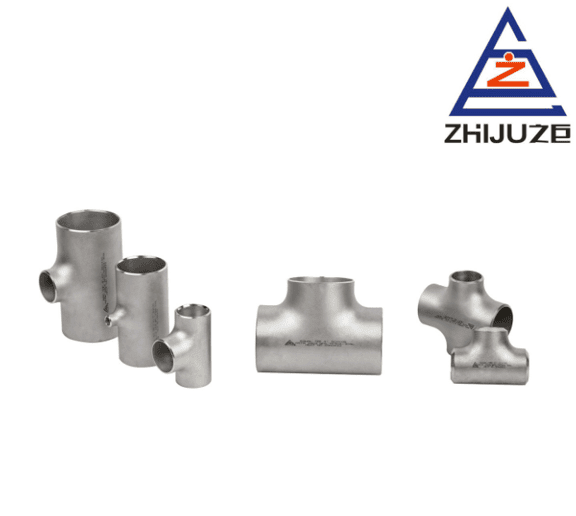
Non – standard pressure – reducing three – way valves are the most commonly used three – way pipe fittings in nuclear pipelines. They’re mainly used between the main pipeline and the branch monitoring pipeline to handle medium diversion and pressure stabilization. They have three non – negotiable usage standards: 1. Uniform and stable wall thickness: In the area of the valve shoulder where it’s most likely to thin, the thickness loss must not exceed 12.5% of the standard thickness. 2. Smooth inner cavity with no dead ends: There should be no sharp corners or depressions on the inner wall to prevent the cooling medium from forming eddies and scouring the pipe wall. 3. Traceability throughout the life cycle: Each nuclear – grade three – way joint has a unique and exclusive number, and there are complete records from production to commissioning. All relevant materials are properly archived, covering the entire 60 – year design life of the equipment.
A complete set of special processing standards for pipes in a radiation environment covers the entire process from raw material smelting, forging, heat treatment, surface polishing to final packaging.
To produce radiation-resistant stainless steel three-way valves that are truly suitable for the nuclear power plant environment, the entire production process has to be strictly controlled. The complete standard steps are as follows:
Precise material selection
Only ultra-low carbon stainless steel plates produced by the AOD refining process are used. Each batch of raw materials needs to go through PMI spectral composition testing to precisely control the content of core elements such as chromium, nickel, and molybdenum.
Integrated hot forging
This process uses large-scale hot forging technology with a minimum forging ratio of up to 3.5. This method ensures that the internal structure of the metal is continuous and dense, completely eliminating internal defects such as pores and cavities and avoiding potential safety hazards.
Dual solid-solution stable heat treatment
The dual solid-solution heat treatment process can be carried out uniformly. It not only eliminates the residual stress generated during the forging process but also refines the metal grain structure, significantly improving the radiation resistance and toughness of the steel.
High-precision internal and external polishing
The inner and outer walls of the pipe fittings will be finely polished, and the surface roughness Ra is uniformly controlled to ≤6.3 μm. The smooth inner wall can prevent the accumulation of radioactive impurities to the maximum extent.
Dust-free sealed production and packaging
All processes are completed in a clean workshop with dust-free operation throughout and sealed packaging. This ensures that the product cleanliness meets the nuclear-grade requirements.
The production of nuclear-grade three-way valves must strictly follow the RCC-M, ASME Class III standards, and the complete set of domestic NB/T nuclear power regulations. The specific control requirements are as follows:
Welding qualification control: All operators must hold nuclear-grade welding qualifications. Before mass production, the welding procedure specification (WPS) and process evaluation record (PQR) must be submitted. Production can only start after the process is confirmed to meet the requirements.
Precise dimensional tolerances: The angle deviation of the branch pipe must not exceed 0.5°, and the overall ovality must be strictly controlled within 5%.
Clean and oil-free throughout the process: There should be no oil pollution during the forming and polishing processes, and the particle residues must be strictly controlled. • Independent production line: Nuclear-grade three-way valves have an independent and exclusive production line, completely separated from ordinary sanitary-grade three-way valves and industrial pipe fittings. This can completely avoid the problems of raw material mixing and grade confusion.
This radiation-resistant pipe three-way joint is equipped with a complete closed-loop quality assurance supervision system:
All process-related data are permanently archived, including raw material certificates, forging temperature data, heat treatment curves, and all non-destructive testing reports. This ensures that the product can be traced throughout its entire life cycle.
Comprehensive non-destructive testing in four processes: The finished products are 100% inspected by ultrasonic testing (UT), radiographic testing (RT), penetrant testing (PT), and magnetic particle testing (MT). All detected defects meet the highest-level acceptance criteria (Grade I).
Routine sampling performance testing: Each batch of products is randomly sampled. Through irradiation simulation tests, high-temperature creep tests, and intergranular corrosion tests, the radiation resistance, high-temperature resistance, and corrosion resistance of the materials during long-term use are verified. 4. Third-party authoritative inspection: Before product manufacturing, random inspections and reviews will be carried out by the official nuclear safety agency to ensure that no substandard products appear in the project.
| Inspection Item | Nuclear Primary Loop Reducing Tee | Ordinary Stainless Steel Tee |
| NDT Coverage | 100% full body four-type detection | Partial UT+PT sampling |
| Wall Thickness Tolerance | ±10% nominal thickness | ±15% nominal thickness |
| Surface Roughness | Ra ≤6.3μm internal & external | Ra ≥12.5μm unpolished inner wall |
| Mandatory Radiation Test | Simulated neutron aging impact test | Not required |
| Traceability Period | Full 60-year file storage | Only 3–5 years simple records |

A lot of purchasers tend to mix up nuclear-specific three-way valves with those used in food and pharmaceutical production workshops. But, there’re significant differences between these two types of pipe fittings in terms of design goals and core performance:
Different focuses on applicable conditions: Nuclear-grade three-way valves mainly emphasize the ability to resist radiation, high temperatures, and high-pressure creep. While sanitary-grade three-way valves only need to have the performance of resisting bacterial growth and acid-alkali flushing.
Big differences in raw material control standards: Nuclear-grade pipetees must use ultra-low carbon stainless steel and have strict restrictions on impurities to prevent the material from becoming brittle after long-term radiation. However, the 316L stainless steel used for sanitary purposes on the market has looser requirements for impurity control and doesn’t need radiation-related tests after leaving the factory.
Different manufacturing process requirements: Nuclear-grade three-way valves must be formed through a single forging process to ensure the integrity and continuity of the internal structure of the steel. While sanitary-grade three-way valves can be formed through a separate welding process.
Big differences in quality inspection standards and review thresholds: Nuclear three-way valves need to comply with comprehensive non-destructive testing of various types and radiation simulation tests. While sanitary pipeline tees only need to have a smooth surface treatment and a simple check on corrosion resistance.
Can an ordinary stainless-steel three-way valve be used in the main circuit of a nuclear power plant after modification?
No. Ordinary three-way valves haven’t been refined to enhance radiation resistance and lack a complete non-destructive testing report. Only products that fully meet the manufacturing standards of stainless-steel three-way valves for the main circuit of nuclear power plants can be put into use.
What key tests should be carried out to evaluate the radiation resistance of stainless pipe tees?
The core test items include three: simulated neutron irradiation impact test, high-temperature tensile test, and intergranular corrosion detection. When these three tests are used together, it can be confirmed that the steel won’t become brittle even after 60 years of continuous use.
Which manufacturer can provide three-way valves that meet nuclear-grade standards and provide a full set of testing materials?
ZHIJU has a complete nuclear safety production qualification certificate. All three-way valves for the main circuit need to go through four rounds of comprehensive non-destructive testing, and each batch of products can provide complete material traceability documents and testing reports.
Are the polishing standards for nuclear-grade pipe tees and sanitary-grade pipe tees different?
Yes, they are. Sanitary-grade three-way valves require extremely smooth inner walls, and the surface roughness needs to be controlled at Ra ≤ 0.4 μm. While nuclear-grade stainless-steel three-way valves need to strike a balance between inner wall smoothness and metal surface integrity. To prevent accelerated radiation aging due to surface damage, a unified polishing standard of Ra ≤ 6.3 μm is adopted.
During the construction of the main circuit pipeline of a nuclear power plant, if the specific production and testing standards of pipe tees in a radiation environment are ignored, it will leave permanent and irreparable nuclear safety hazards. Whether you’re building a new nuclear island project or renovating an old unit, when purchasing standard-diameter stainless-steel pipe tees or adjustable-flow pipe tees, you shouldn’t just go for the low price of ordinary pipe tees. Instead, you should give priority to nuclear-grade products that have passed a full set of radiation performance tests, 100% full-piece non-destructive testing, and have complete life-cycle traceable information.
ZHIJU‘s full range of nuclear-grade three-way products strictly follow all domestic and international nuclear safety standards. The standardized forging, heat treatment, and multi-layer quality inspection processes cover every aspect. From the source of production, it effectively avoids the risk of steel material failure due to radiation. If you have customized requirements for pipe tees for the main circuit of a nuclear power plant or want to verify a full set of compliant materials and test documents, please contact our professional technical team right away. The technicians will assist you in completing the nuclear safety approval process according to your main circuit design parameters.

THE QUALITY IS THE SOUL OF AN ENTERPRISE
Zhejiang Zhiju Pipeline Industry Co., Ltd
Official Website: https://www.zhiju-steel.com
Privacy Policy
Copyright ZHEJIANG ZHIJU PIPELINE INDUSTRY CO., LTD SUPPORT BY :JUNJ