- Whatsapp: 8618958900507
- Email: [email protected]


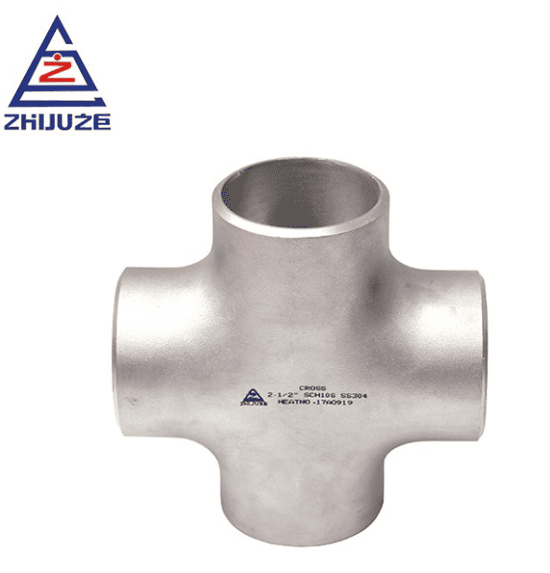
Metal forming is the core process for manufacturing all kinds of industrial pipe fittings. Its basic principle is to use external force to shape the raw – material metal. This method doesn’t need a lot of cutting and doesn’t waste raw materials. The pipes produced have a stronger and more durable overall structure. Pipe cross, also known as reducing cross pipe fitting, are key components used to divert fluid in four directions in a pipeline system. They’re widely used in chemical equipment, hydraulic pipelines, and all kinds of process pipelines. Forming methods suitable for mass production, like continuous rolling and fully – automatic stamping production lines, are super efficient and have a reasonable unit cost, but they’re totally unsuitable for small – batch custom orders.
This article is gonna give a full analysis of: the production requirements for custom orders, the pros and cons of different forming processes, how to choose and judge the right process flow, and the complete forming workflow from start to finish. It’ll guide you step by step on how to choose the right forming solution for small – batch custom reducing pipes.

Here are the main hard requirements for small – batch custom reducing cross fittings:
Flexible size customization: It can provide four – way profiles with equal diameter, reduced diameter, eccentricity, and special angles. The forming parameters need to be adjusted separately for each type.
Suitable for a variety of metal materials: Carbon steel, 304/316 stainless steel, alloy steel, and various non – ferrous metals can adapt to different working environments, like corrosion resistance and high – pressure resistance.
Strict tolerance control: Even if you only make a few dozen samples, the dimensions must meet the ASME, DIN industry standards or the customer’s drawing requirements.
Low mold cost: If the order is less than 50 pieces, it’s hard for customers to bear the high cost of custom molds required for large – scale production.
The delivery cycle is usually very tight: Most sample and trial – production orders need to be completed in 7 to 15 days, but the production time for special molds dedicated to stamping and hot forging takes more than two weeks. So, it almost always delays the whole project progress.
There’s no guarantee of repeat orders: Many custom four – way joints are only used for a specific project and won’t be repurchased later. So, you can’t get back the money invested in the molds.
Products of different sizes are mixed in the same batch: An order may contain three or five four – way joints of different sizes. You have to change the molds frequently, and large – scale production lines can’t switch this requirement flexibly.
| Forming Craft | Applicable Batch Size | Material Scope | Upfront Die Cost | Dimensional Precision | Core Advantages for Custom Cross |
| CNC Machining from Bar Stock | 1–100 pcs | All metal alloys | No custom die needed | Ultra-tight tolerance | Fast setup, fully customizable shapes |
| Cold Hydraulic Bulging | 10–200 pcs | Thin-wall carbon & stainless steel | Low universal mold cost | Medium precision | Integrated one-piece forming, smooth inner cavity |
| Hot Press Forming | 20–300 pcs | Thick-wall alloy & stainless steel | Medium die cost | High structural strength | Fits heavy-duty high-pressure cross fitting |
| Die Forging | ≥500 pcs | All structural steel | Very high custom die cost | Excellent mechanical performance | Not recommended for tiny batches |
| Sheet Welded Assembly | 1–50 pcs | Thin-wall stainless steel | Zero dedicated mold | Low uniformity | Lowest initial cost for ultra-small prototypes |
From the above process comparison, it can be seen that forging and continuous stamping are only suitable for large-scale production. For small-batch and customized cross pipe fittings, the mainstream and reliable methods mainly include CNC machining, hydraulic expansion, and hot pressing.
To produce small batches of four-way pipe fittings at the lowest cost, the process should be flexibly selected according to the order quantity and usage scenario:
For sample orders of 10 pieces or less: It is recommended to use CNC bar machining. No mold is needed, and the complete four-way structure can be directly machined according to the drawing. The only drawback is that the material loss is slightly higher.
For four-way pipe fittings with the same diameter and thin wall thickness (10–200 pieces): Cold hydraulic expansion is the most cost-effective solution. The universal mold can be adjusted in size, eliminating the need for additional mold manufacturing costs.
For four-way pipe fittings with thick wall thickness, high pressure, and different diameters (20–300 pieces): Hot pressing should be the top choice. Heating at high temperatures can reduce the hardness of the metal, making it easier to machine and shape. It is less likely to crack during the branching expansion process, and there’s no need for custom molds, thus avoiding high costs.
For situations with extremely low budgets and only for experimental samples: Sheet metal welding can be used to completely eliminate mold costs. However, after welding, additional polishing and sealing tests are required to ensure the sealing performance.
First, check the order quantity: When the quantity is less than 10 pieces, choose CNC machining; when the quantity is between 10 and 300 pieces, give priority to hydraulic forming or hot pressing.
Then, consider the wall thickness and pressure: For thin-walled, low-pressure applications, cold hydraulic forming should be used; for thick-walled, high-pressure pipes, hot pressing must be used.
Determine the process according to the material: Aluminum, copper, and thin stainless steel have good ductility and are suitable for cold forming; high-hardness alloy steel must be heated before processing.
Finally, confirm the delivery date: If the project cycle is less than 10 days, direct hot forging and custom stamping dies should be avoided.
Apart from the order quantity, there are four key factors that directly affect the applicability of the process:
Structural complexity: Four-way joints with special shapes, variable diameters, eccentricities, and special angles can only be machined by the most flexible CNC machines; for ordinary standard equal-diameter four-way joints, hydraulic forming is more cost-effective.
Surface quality requirements: The inner wall of the hydraulic integrated mold should be smooth and seamless, which is especially suitable for fluid transportation; welding will produce welds, which require subsequent grinding and polishing.
Post-processing requirements: If galvanizing, passivation, or spraying of anti-rust layers is required later, multiple processes can be selected; but for food-grade and medical-grade clean four-way pipe fittings, a seamless integrated forming process must be used.
Are there any repeat orders? If the custom specifications will be frequently ordered in the future, prepare the universal molds in advance.

The newly made four-way pipe fittings are currently only in the rough machining state. To meet the finished product standards, a full set of post-processing procedures must be completed.
Comprehensive dimensional inspection: Measure the wall thickness of each product, check the concentricity in all directions, and calibrate all dimensional tolerances to ensure accurate assembly.
Professional surface treatment: For stainless steel pipe fittings, perform pickling and passivation to prevent corrosion; for carbon steel cross pipe fittings, apply anti-rust paint or hot-dip galvanize as needed.
Pressure leakage test: Conduct a hydraulic test at 1.5 times the rated pressure to detect any leakage problems in the welds and formed joints.
Customize end face machining according to the requirements of the connecting pipes: including mechanical threads, welding grooves, or flange interfaces.
Marking, packaging, and archiving: Use a laser to engrave material, specification, and batch information for subsequent product traceability.
Is the hydraulic stamping process suitable for small-batch production of customized four-way pipe fittings with different diameters?
Ordinary general hydraulic molds are only suitable for manufacturing four-way pipe fittings with the same diameter. If the customized design involves variable diameters or irregular shapes and the order quantity is less than 100 pieces, using CNC machining would be more flexible and efficient.
Why is it not recommended to use the die forging process for small-batch customized four-way pipe fittings?
The biggest problem with the die forging process is the high cost and long cycle. Each size of four-way pipe fitting requires a separate set of upper and lower forming molds. If the order quantity is within 500 pieces, the cost of the mold itself already exceeds the value of the product, and the economic benefit is extremely poor.
How can we strike a balance between low cost and high compressive performance when customizing four-way pipe fittings?
This process can be flexibly adjusted according to the working conditions. For thin-walled low-pressure fluid pipelines, the cold hydraulic expansion method is the most economical. For high-pressure thick-walled pipelines in the chemical industry, hot pressing should be prioritized to obtain better structural strength.
What are the main disadvantages of four-way joints made by welding metal sheets?
The weld seam of welded four-way joints is relatively weak. Since the pipeline is subjected to long-term pressure fluctuations, the weld area is most prone to corrosion, cracking, and leakage. Therefore, four-way joints manufactured using this process are only suitable for temporary low-pressure testing.
In short, when choosing the forming process for customized reducing cross pipe fittings, we can’t rely on a single standard. We must comprehensively consider factors such as order quantity, material characteristics, pressure requirements, and delivery cycle. Every step in the entire production process, from the analysis of small-batch customization requirements, comparison of forming processes, process selection, to the inspection and surface treatment after forming, will affect the final quality, precision, and overall cost of four-way pipe fittings.
The professional pipe fitting manufacturer ZHIJU can provide one-stop customized solutions for four-way pipe fittings of various specifications, including process selection, small-batch trial production, post-treatment, and pressure testing services. If you’re not sure which forming process to use for your project or you want to optimize the production cost of small-batch orders, feel free to consult our technical team anytime. We’ll customize a production plan based on your specific conditions.

THE QUALITY IS THE SOUL OF AN ENTERPRISE
Zhejiang Zhiju Pipeline Industry Co., Ltd
Official Website: https://www.zhiju-steel.com
Privacy Policy
Copyright ZHEJIANG ZHIJU PIPELINE INDUSTRY CO., LTD SUPPORT BY :JUNJ