- Whatsapp: 8618958900507
- Email: [email protected]


In the complex geometry of industrial piping, engineers often need to distribute fluid in four directions. While Elbows and Tees are the “bread and butter” of piping systems, sometimes a more specialized component is required: the Pipe Cross.
Also known as a 4 way pipe fitting, a Pipe Cross looks exactly like it sounds—it has one inlet and three outlets (or vice versa), forming a cross shape. It allows fluid to flow in four directions simultaneously.
At Zhiju Steel, we often see customers hesitating between using a single Cross or fabricating a solution using multiple Tees. This article will explain what a Pipe Cross is, its different types, and why it is often the superior engineering choice for compact systems.
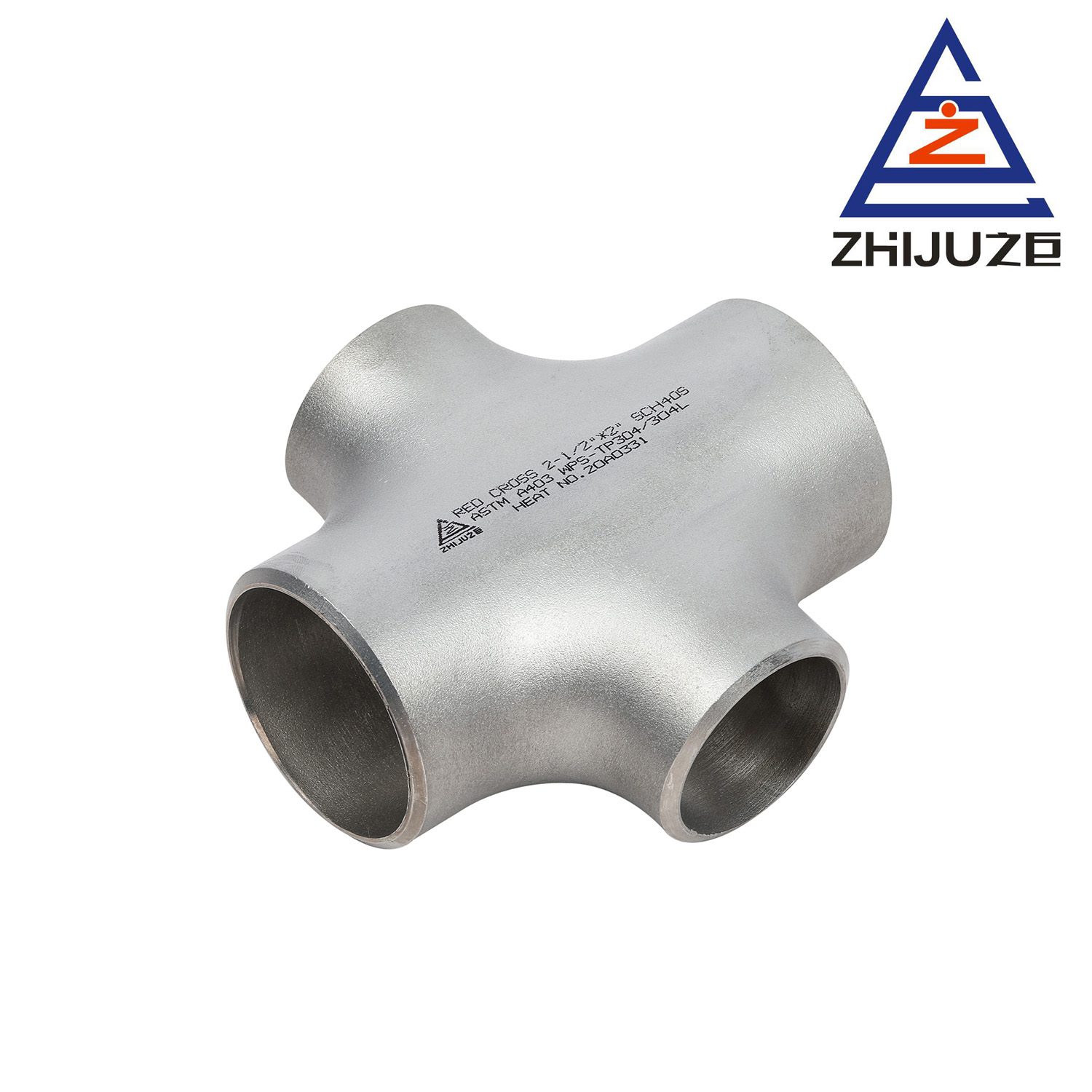 2. Types of Pipe Crosses: Equal vs. Reducing
Just like Tees, cross pipe fittings come in two primary configurations depending on the pipe diameters involved.
In an Equal Cross, all four ends have the same diameter.
Application: Used when the fluid needs to be split equally in all directions, such as in fire sprinkler grids or structural pipe networks.
In a Reducing Cross, the main run pipes are one size, while the branch pipes are smaller.
Application: Used when the main line needs to feed smaller distribution lines without installing additional reducers.
Zhiju Capability: Since reducing crosses are rarely found in stock, Zhiju specializes in manufacturing these to your specific dimension requirements (e.g., 4″ Main x 2″ Branch).
This is the most common question engineers ask: “Why should I search for a specific Cross when I can just weld two Tees together?”
It is true that you can build a 4-way intersection by welding two Pipe Tees together (with a short nipple in between). However, using a single cross fitting offers significant advantages:
A single Cross is much more compact than two Tees welded together.
Use a Cross: If you are designing piping for a skid, a ship, or a cramped pipe rack, a Cross saves valuable installation space.
Let’s look at the welding requirements:
Two Tees Strategy: Requires 6 welds (Main Inlet, Tee-to-Nipple, Nipple-to-Tee, Main Outlet, plus 2 Branches).
One Cross Strategy: Requires only 4 welds.
Conclusion: Fewer welds mean fewer potential leak points, less welding labor, and lower Non-Destructive Testing (NDT) costs.
A Cross allows for a centralized flow distribution, whereas two Tees create a staggered flow which can induce slightly more turbulence and pressure drop.
Because cross fittings handle stress from four directions, manufacturing quality is critical. The center of the “X” is a high-stress zone, and poor manufacturing can lead to dangerous wall thinning.
At Zhiju Steel, we adhere to strict international standards:
Standard: ASME B16.9 (Factory-Made Wrought Buttwelding Fittings). This ensures the dimensions match your pipes perfectly.
Materials: We focus on corrosion-resistant materials, primarily Stainless Steel Cross Fittings (Grades 304/304L and 316/316L).
Process: We utilize advanced hot forming and cold extrusion technologies to ensure uniform wall thickness throughout the fitting, even at the critical center point.
Where are pipe crosses actually used? They are less common than Tees but are essential in specific industries:
Fire Sprinkler Systems: This is the most common use case. Crosses are used to distribute water evenly across a ceiling grid.
Chemical Processing: Used in complex manifolds where multiple lines converge.
HVAC Systems: For efficient distribution of heating or cooling fluids in tight mechanical rooms.
While Pipe Crosses offer superior space efficiency and fewer leak risks compared to using multiple Tees, they can be harder to find in standard stock.
This is where Zhiju Steel comes in.
As a dedicated manufacturer, we don’t rely on market stock. We can manufacture Equal Crosses and Reducing Crosses to your exact project specifications with short lead times.
Don’t compromise your design. If your project needs the efficiency of a stainless steel cross fitting, contact us directly.
THE QUALITY IS THE SOUL OF AN ENTERPRISE
Privacy Policy
Copyright ZHEJIAGN ZHIJU PIPELINE INDUSTRY Co.,Ltd SUPPORT BY :JUNJ