- Whatsapp: 8618958900507
- Email: [email protected]


Imagine this scenario: A maintenance engineer at a beverage plant orders a “2-inch” sanitary valve replacement. When it arrives, he tries to weld it to the existing line, only to find the new valve is 3 millimeters larger than the pipe. Production stops, and money is wasted.
This is a classic case of mixing up standards: The pipe was likely DIN standard (DN50), while the valve was 3A standard (2 Inch).
In the global food and beverage industry, two dominant standards often clash: the American 3A Standard and the European DIN Standard. While both ensure safety, their dimensions are not compatible.
At Zhiju Steel, we manufacture a complete range of Sanitary Polish Fittings in both standards. This guide will help you understand the differences, specifically for sanitary tee and reducer connections, ensuring you order the right parts every time.
 What is the 3A Standard?
The 3-A Sanitary Standards originated in the United States and are widely adopted in the Americas and parts of Asia.
Unit of Measure: Imperial (Inches).
Tube Sizing: The size refers to the strictly controlled Outside Diameter (OD) of the tube.
Example: A 1″ 3A tube has an exact OD of 25.4mm.
Common Connection: Tri clamp fittings (Clamp end) and Butt Weld ends are the most common connections in 3A systems.
If your facility processes dairy products (milk, cheese, yogurt), you are likely using food grade pipe fittings that adhere to 3A standards.
DIN (Deutsches Institut für Normung) standards originated in Germany and are the dominant choice in Europe.
Unit of Measure: Metric (Millimeters).
Tube Sizing: Sizes are referred to by “DN” (Diameter Nominal).
Example: DN25 is often confused with 1 Inch, but the OD of a DIN 11850 Series 2 tube is actually 28mm or 29mm, not 25.4mm.
Primary Industry: DIN fittings are the standard choice for brewery pipe fittings and many pharmaceutical applications.
Key Takeaway: Never assume DN25 equals 1 Inch. They will not fit together without an adapter.
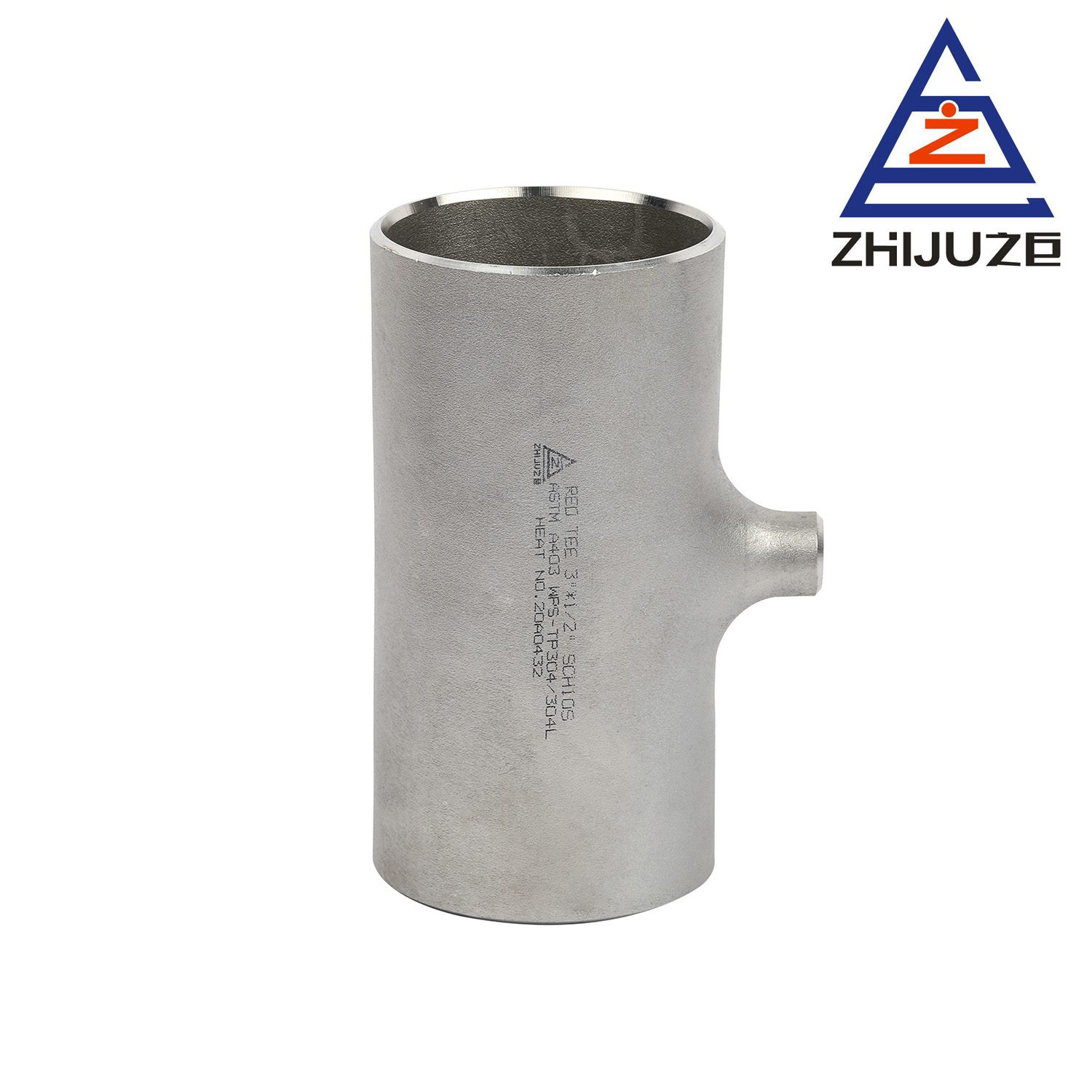
When ordering a sanitary tee, dimension A (Face-to-Center) is critical for layout planning.
3A Sanitary Tees: These typically have a compact design. The leg lengths are standardized in inches. They are designed for efficient flow in dairy lines.
DIN Sanitary Tees (DIN 11852): These tees often feature slightly different leg lengths compared to their 3A counterparts. The wall thickness is also metric, which affects the welding process.
If you try to weld a 3A sanitary tee into a DIN pipeline, you will face a “step” at the weld joint due to the OD mismatch. This step creates a hygiene risk where bacteria can grow.
Reducers are essential for changing line sizes, for example, connecting a pump to a smaller pipeline.
3A Reducers: Available as sanitary concentric reducer (cone shape) and eccentric reducer (flat side). They are characterized by a specific length defined by the 3A standard to ensure smooth flow transition.
DIN Reducers: DIN standard reducers (like DIN 11852) have specific metric lengths and taper angles designed to match metric tube sizes (e.g., reducing from DN50 to DN40).
Whether you need a sanitary concentric reducer for a vertical pipe or an eccentric one for a horizontal pump inlet, you must specify the standard to match the connecting tubes.
Regardless of the dimension (3A or DIN), the most important factor for hygienic stainless steel fittings is the internal surface quality.
Rough surfaces trap bacteria. That is why industry standards dictate a specific surface finish Ra value.
3A Requirement: Typically requires an Ra value of ≤0.8μm (32μin Ra).
Zhiju Quality: We go beyond the basic requirement. Our sanitary fittings undergo mirror polishing to achieve an Ra value of 0.4μm to 0.8μm.
This ultra-smooth finish ensures that your Clean-in-Place (CIP) system can effectively remove all residues, guaranteeing food safety.
To help you identify which standard your plant uses, refer to this quick comparison table.
Table 1: 3A (Inch) vs. DIN (Metric) Comparison
| Feature | 3A Standard | DIN Standard (e.g., DIN 11850) |
| Origin | USA | Germany / Europe |
| Measurement Unit | Imperial (Inch) | Metric (Millimeter) |
| Size Code | 1″, 1.5″, 2″ | DN25, DN40, DN50 |
| Tube OD (Approx.) | 1″ = 25.4 mm | DN25 = 28 mm (Series 1) or 29 mm (Series 2) |
| Key Industry | Dairy, Food (Americas/Asia) | Brewery pipe fittings, Pharma (Europe) |
| Connections | Tri clamp fittings, Butt Weld | DIN 11851 Union, Flange, Butt Weld |
Choosing the right sanitary fittings is the first step in building a safe and efficient production line. Mixing 3A and DIN standards can lead to installation nightmares and hygiene risks.
Check your existing pipes: Measure the Outside Diameter (OD) in millimeters.
Check the standard: Is it 25.4mm (3A) or 29mm (DIN)?
Need help identifying your fittings?
Zhiju Steel manufactures high-quality food grade pipe fittings in both 3A and DIN standards. Whether you need a customized sanitary concentric reducer or a standard tee, we have the molds and expertise to deliver.
Contact Our Engineers today for a catalog or technical support

THE QUALITY IS THE SOUL OF AN ENTERPRISE
Privacy Policy
Copyright ZHEJIAGN ZHIJU PIPELINE INDUSTRY Co.,Ltd SUPPORT BY :JUNJ