- Whatsapp: 8618958900507
- Email: [email protected]


In any industrial piping system, flanges are the “joints” that hold everything together. They allow for easy cleaning, inspection, and modification. However, choosing the wrong flange type can lead to leaks, pressure failures, and costly downtime.
While the ANSI B16.5 flange types standard lists numerous designs, three specific types dominate 80% of industrial applications: the Slip-On, the Weld Neck, and the Blind Flange.
At Zhiju Steel, we manufacture high-quality stainless steel flange products for clients worldwide. This guide will break down the differences between these core types, explain face seal options, and help you select the right pipe flange for your specific project.
 The Big Three: Core Flange Types
If you are ordering flanges for a petrochemical plant, a water treatment facility, or a food processing line, you will likely encounter these three designs.
As the name suggests, this flange slips over the pipe. It is then fillet-welded both inside and outside to provide strength and prevent leakage.
Pros: It is easier to align than a weld neck flange because the pipe slides into the flange before welding. It is also cheaper due to less material usage.
Cons: The internal weld can be difficult to inspect.
Comparison: When debating slip on flange vs weld neck, remember that Slip-Ons are generally preferred for lower pressure, less critical applications where cost is a major factor.
This flange features a long tapered hub that goes gradually over to the wall thickness from a pipe or fitting. It is butt-welded to the pipe.
Pros: The hub transfers stress from the flange to the pipe, reducing high-stress concentrations at the base of the flange. This makes it ideal for high-pressure or high-temperature applications.
Cons: More expensive to manufacture and requires precise cutting of the pipe length for installation.
Application: Essential for critical safety lines and steam loops.
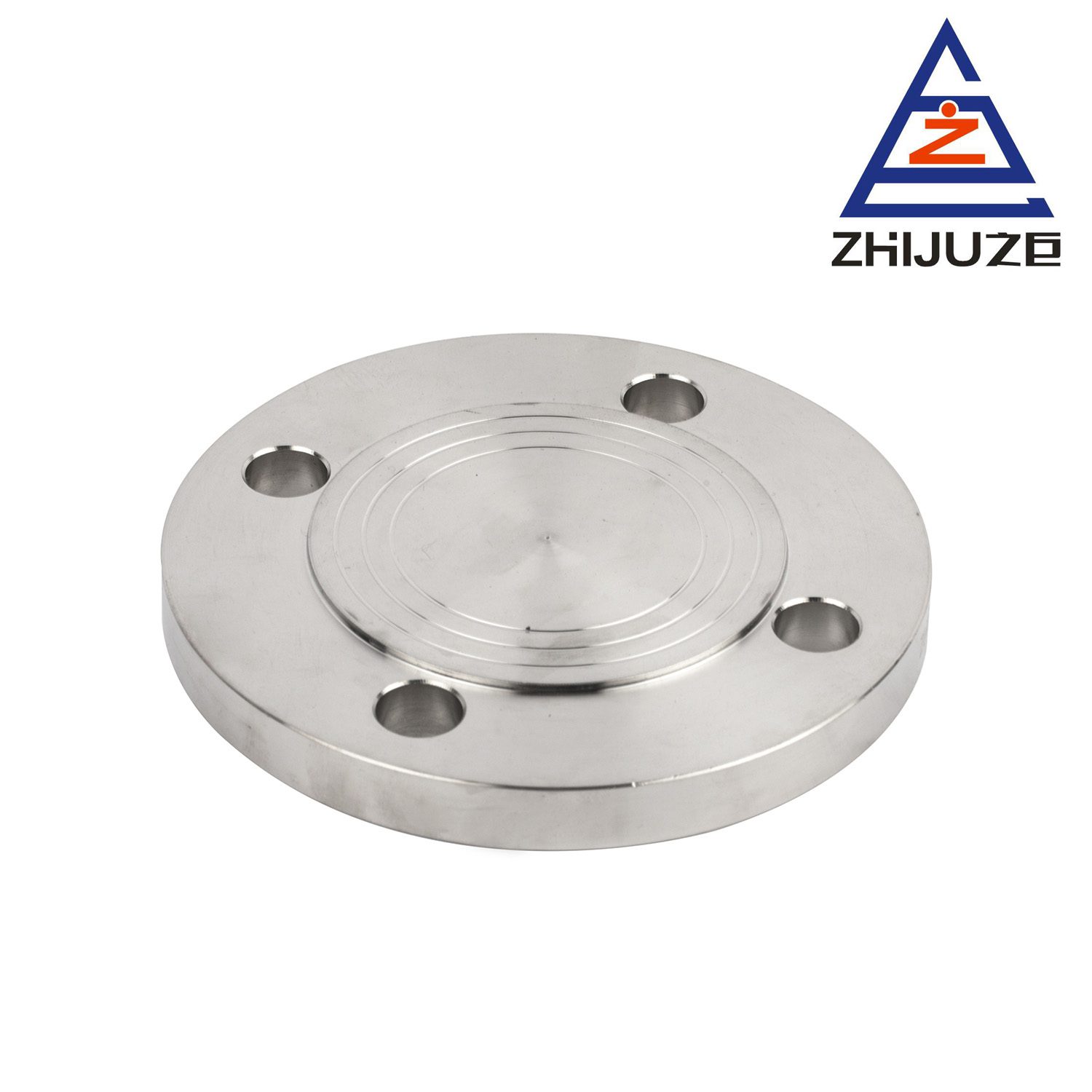
Unlike the other two, a Blind Flange has no bore. It is a solid steel disc used to block off a section of pipe or a nozzle on a vessel.
Pros: Allows for easy access to the interior of a line or vessel once it has been sealed.
Key Consideration: Because it blocks the flow, it experiences the maximum mechanical stress due to system pressure. Therefore, checking correct blind flange dimensions and thickness is critical for safety.
While the “Big Three” cover most needs, specialized applications require specialized flanges:
Socket Weld Flange (SW): Similar to a Slip-On but with a recess (socket) for the pipe to sit in. Used primarily for small-bore, high-pressure pipes.
Threaded Flange (TH): Connects via internal threads without welding. Ideal for areas where welding is hazardous (explosive environments).
Lap Joint Flange (LJf): Used in conjunction with a Stub End. The flange can rotate freely, making bolt alignment easy.
Note: This is a great cost-saving option for stainless steel systems.
Selecting the flange body is only half the battle; you must also select the correct sealing face. The most common confusion arises around raised face vs flat face flange designs.
Raised Face (RF): The most common type. The gasket surface is raised above the bolting circle face. This concentrates more pressure on a smaller gasket area, creating a better seal.
Flat Face (FF): The gasket surface is in the same plane as the bolting circle face.
Critical Rule: Never bolt a Raised Face flange to a Flat Face flange (especially cast iron). It can crack the flange.
Ring Type Joint (RTJ): Features a groove cut into the face. A metal ring gasket sits in this groove. Used for extremely high-pressure/temperature services (Class 900 and above).
At Zhiju Steel, we supply flanges in various grades to match your piping environment.
304/304L: The standard “workhorse” grade. excellent for general water and air lines. A standard class 150 stainless steel flange in 304L is the most common item in our inventory.
316/316L: Contains Molybdenum for superior pitting resistance. Mandatory for marine environments and chemical processing.
Duplex (2205): Offers twice the strength of 316L and exceptional stress corrosion cracking resistance.
To simplify your decision, here is a quick comparison of the most popular ANSI B16.5 flange types.
Table 1: Flange Selection Guide
| Flange Type | Cost | Pressure Resistance | Installation Difficulty | Best Use Case |
| Slip-On (SO) | Low | Moderate | Easy (Easy alignment) | Water lines, low-pressure process lines. |
| Weld Neck (WN) | High | High | Hard (Requires precision) | High pressure, severe service, fluctuating temperatures. |
| Blind (BL) | Moderate | High | Easy | Closing pipe ends, manholes. |
| Lap Joint (LJf) | Low | Moderate | Very Easy (Rotatable) | Systems requiring frequent dismantling or cleaning. |
Choosing the right stainless steel flange is a balance between system requirements (pressure, temperature) and budget.
Use Weld Neck for critical, high-stress lines.
Use Slip-On for general, low-pressure utility lines.
Always ensure you match the Face Type (RF vs FF) correctly to prevent leaks.
Need help with specifications?
Zhiju Steel manufactures a full range of flanges compliant with ASME/ANSI B16.5. From a simple class 150 stainless steel flange to complex high-pressure custom parts, we have you covered.

THE QUALITY IS THE SOUL OF AN ENTERPRISE
Privacy Policy
Copyright ZHEJIAGN ZHIJU PIPELINE INDUSTRY Co.,Ltd SUPPORT BY :JUNJ